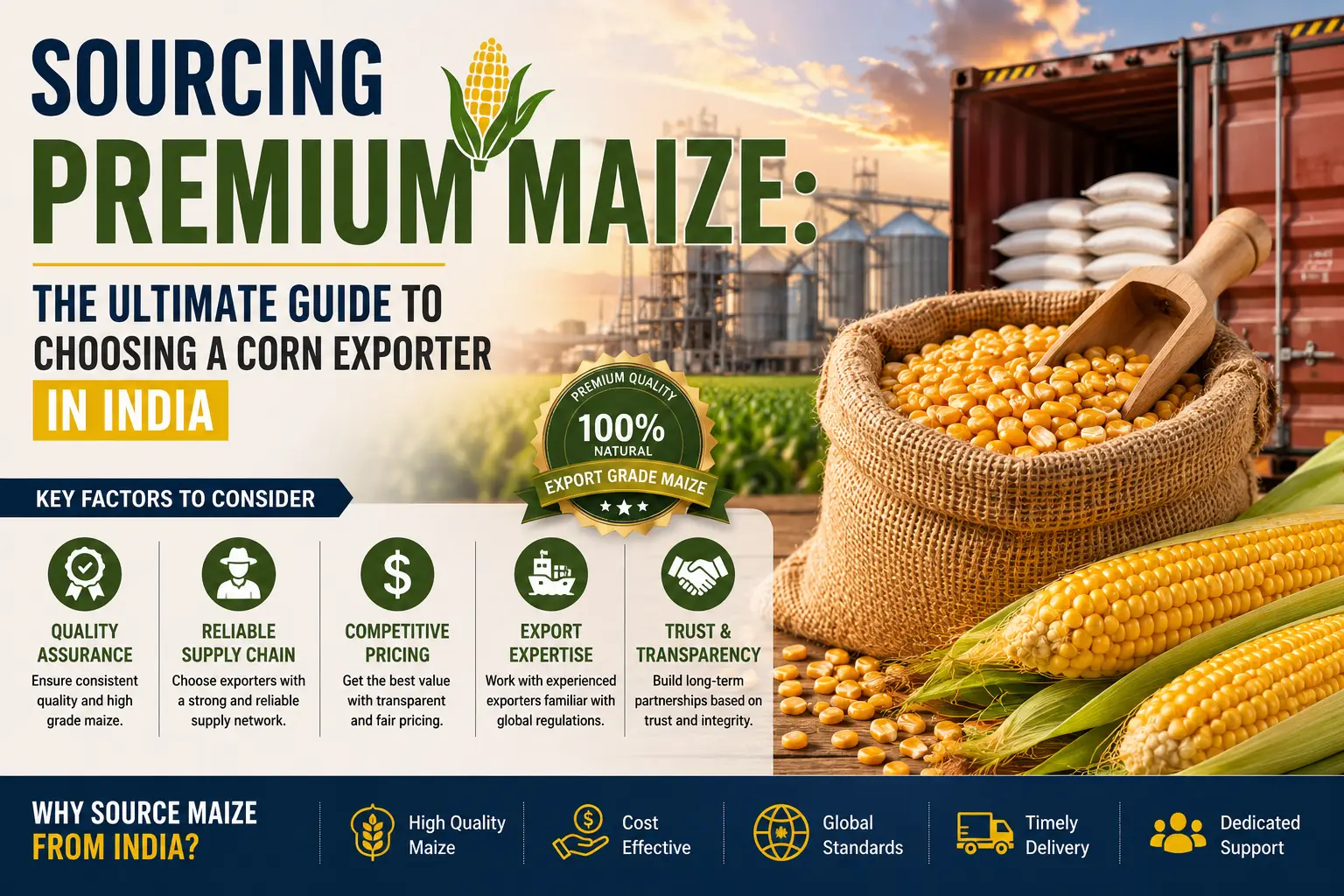
If you are evaluating a Corn Exporter India supplier, the most important decision is not simply who offers the lowest price. The right exporter should consistently deliver the grade, moisture level, packaging format, documentation, and shipment reliability your business needs to protect production schedules, feed performance, or food quality.
For importers, processors, feed manufacturers, and food ingredient buyers, maize is a high-volume commodity where small sourcing mistakes create expensive downstream problems. A poor cargo can trigger storage losses, delayed processing, customer complaints, quality disputes, and avoidable working-capital pressure. That is why experienced buyers assess exporter capability as carefully as they assess the corn itself.
What is a corn exporter? A corn exporter is a company that sources, processes, quality-checks, documents, packs, and ships maize to international buyers according to agreed commercial and technical specifications. In practice, a capable exporter acts as a supply-chain coordinator, ensuring that product quality, loading standards, regulatory documentation, and logistics execution align with the buyer’s end use.
India remains relevant in global agri trade because buyers often want supply diversification, flexible packaging, responsive communication, and access to broader commodity portfolios from one source. Companies looking beyond single-product buying often prefer suppliers that can also support related needs such as starch, flours, feed ingredients, sugar, salt, spices, sesame, and rice. That broader sourcing logic is one reason many international buyers work with established agri products exporters from India rather than managing multiple fragmented vendor relationships.
Why maize sourcing decisions matter more than many buyers expect
Maize is often treated as a straightforward commodity purchase, but procurement teams know that specification mismatches are rarely simple. A shipment that appears acceptable on paper can still create operational friction if grain size is inconsistent, foreign matter is above tolerance, moisture is not well controlled, or packaging fails in transit. In food processing and feed manufacturing, these issues move quickly from procurement to operations.
For feed businesses, maize quality affects formulation stability, handling characteristics, and storage confidence. For food processors, consistency matters for milling output, flour quality, starch yield, and end-product performance. A buyer selecting a supplier for human consumption use will often prioritise cleanliness, uniformity, low contamination risk, and process discipline differently from a buyer focused on bulk feed use.
Another overlooked factor is how exporter responsiveness affects business continuity. When a vessel schedule shifts, a phytosanitary clarification is required, or packing details need revision, buyers need fast, precise communication. Delays in document correction can hold cargo, slow customs clearance, or create demurrage exposure long after the commercial invoice has been issued.
This is why procurement leaders increasingly evaluate exporters as operational partners rather than transactional traders. A strong Indian supplier should not only ship maize; it should reduce uncertainty across sourcing, loading, paperwork, and post-shipment coordination. That broader role is especially important for importers serving tight retail, manufacturing, or feed production schedules.
Who typically buys maize from India?
The buyer base is broader than many sellers assume. International demand can come from animal feed manufacturers, poultry integrators, cattle feed producers, starch processors, flour mills, snack and cereal producers, trading houses, and importers serving institutional or industrial customers. Each of these segments evaluates maize through a different lens.
A poultry feed buyer may focus on nutrient consistency, moisture control, and shipment frequency. A food processor may focus more heavily on grain uniformity, hygiene, sorting, and suitability for further processing. A trading company may care most about commercial flexibility, market timing, and exporter reliability under changing destination requirements.
Why do buyers search for Indian agricultural products suppliers?
Search behaviour such as “indian agricultural products suppliers,” “agro exporters in india,” and “agricultural products exporters” shows that many buyers are not looking for maize alone. They are looking for a reliable supply platform. An exporter that can support corn alongside rice, flours, sugar, salt, sesame, pulses, and feed ingredients creates procurement efficiency by reducing vendor management complexity.
That matters in real operating environments. A buyer managing flour sugar salt and other essentials exporters is often trying to simplify shipments, harmonise documents, and build relationships with suppliers that understand export execution across categories. A diversified exporter can support that objective far better than a narrowly transactional broker.
Core benefits of choosing the right Corn Exporter India partner
The clearest benefit of selecting the right exporter is fewer quality disputes after dispatch. Strong exporters put quality checks at the right points in the process: sourcing, cleaning, grading, packing, pre-shipment inspection, and documentation review. This does not eliminate every risk in global trade, but it sharply improves shipment predictability.
A second benefit is smoother operations at destination. Buyers do not just purchase corn; they purchase discharge confidence. When labelling, packing strength, loading condition, fumigation status, and document sets are handled correctly, port handling and customs processing become more manageable for the consignee and clearing teams.
Third, a capable exporter supports commercial flexibility. International buyers often need private packaging, buyer-specific marks, container optimisation, or multi-product shipment planning. Exporters with practical experience can accommodate these requirements without turning every change into a delay or compliance issue.
Fourth, the right supplier improves internal productivity for the buyer. Procurement, quality, finance, and logistics teams spend less time chasing clarifications, correcting paperwork, or resolving preventable cargo issues. In B2B commodity procurement, that reduction in administrative friction is often as valuable as negotiating a marginal price difference.
Operational benefits buyers actually notice
Buyers usually feel the difference in four areas: communication speed, shipment readiness, document accuracy, and consistency between approved sample and loaded cargo. These are practical outcomes, not marketing claims. They affect whether a purchase order moves through the organisation cleanly or becomes a recurring source of follow-up.
Good exporters also help buyers make better purchasing decisions before order confirmation. They explain what is commercially realistic, where specification tightness may affect price, and how packaging choices change logistics. That guidance is especially useful for newer importers or businesses entering a new destination market.
Why a multi-commodity exporter can reduce sourcing risk
Many importers prefer suppliers that can support more than one commodity because business needs rarely remain static. A customer buying maize today may later require rice, chickpeas, peanuts, or starch depending on seasonal demand and manufacturing plans. Working with one exporter that understands cross-category export execution can reduce onboarding time for future purchases.
For buyers who also source rice, it helps to compare supplier maturity across product lines. Reading a related guide such as Rice Exporter in India: A Complete Guide for Global Rice Buyers can reveal whether an exporter understands the wider discipline of international agri commodity supply rather than treating each shipment as a standalone trade.
How to evaluate maize quality, supplier capability, and fit for use
The first buying criterion is specification clarity. Buyers should define intended use before requesting offers: feed, flour milling, starch processing, industrial use, or food manufacturing. Without that context, quotations can look comparable while referring to different quality assumptions.
Start by asking for a complete product specification sheet. At minimum, it should address origin, crop condition, moisture, foreign matter, damaged kernels, admixture, packaging type, loading format, inspection approach, and documentation availability. If the supplier cannot provide a structured specification early, the risk of later ambiguity is high.
Next, evaluate process discipline rather than sales confidence. Ask how maize is sourced, cleaned, graded, stored, packed, and inspected prior to dispatch. A serious exporter should be able to explain its workflow in operational terms, not just say that quality is “best” or “premium.”
Then assess commercial alignment. Some exporters are strong in bulk, some in bagged shipments, some in food-grade handling, and some in feed ingredient trade. The right choice depends on whether your priority is price competitiveness, technical consistency, packaging flexibility, or supply assurance.
Key questions every buyer should ask
What should buyers check before choosing Corn Exporter in general? Buyers should check product specifications, exporter experience, origin consistency, packing options, inspection processes, documentation readiness, shipment planning capability, and responsiveness during the quotation stage. Early communication quality is often a reliable indicator of post-order execution quality.
How can businesses compare Corn Exporter providers? Compare them on sample consistency, willingness to document specifications clearly, ability to accommodate buyer-specific packaging, understanding of destination requirements, logistics coordination, and transparency on terms. A quotation should be evaluated as a service package, not only as a commodity price.
What red flags should concern a buyer? Vague quality descriptions, reluctance to confirm tolerances in writing, inconsistent sample communication, unrealistic lead time promises, and confusion over required export documents are all warning signs. A buyer should also be cautious if the supplier changes commercial terms repeatedly without clear market reasons.
Practical comparison framework
| Evaluation Area | What Strong Exporters Provide | Buyer Risk if Weak |
|---|---|---|
| Product specification | Clear written quality parameters and end-use alignment | Disputes over grade, moisture, or suitability |
| Quality control | Defined cleaning, grading, inspection, and packing steps | Inconsistent cargo and higher rejection risk |
| Documentation | Accurate export documents prepared to destination needs | Customs delays and clearance issues |
| Packaging flexibility | Bulk and customised bagging options where needed | Handling inefficiency and added repacking cost |
| Logistics coordination | Realistic shipment planning and loading communication | Missed schedules and supply disruption |
| Commercial transparency | Clear terms on price basis, lead time, and responsibilities | Unexpected charges and avoidable friction |
Samples can be useful, but buyers should treat them as only one part of evaluation. A strong sample does not guarantee a strong shipment if procurement discipline and loading controls are weak. The more reliable test is whether the exporter can connect sample quality to repeatable sourcing and process controls.
Compliance, traceability, and documentation buyers should not overlook
In agricultural exports, documentation errors can be as disruptive as product defects. Importers should confirm in advance which documents are required for the destination country and for the intended use of the maize. Requirements can vary depending on whether the cargo is for feed, food processing, industrial conversion, or general trade.
Typical export coordination may involve commercial invoice, packing list, certificate of origin, phytosanitary requirements where applicable, fumigation-related documentation where relevant, and shipment documents aligned to the agreed trade terms. The exact set should always be confirmed transaction by transaction. Mature exporters treat documentation as part of quality assurance, not as an afterthought.
Traceability also matters more than many buyers expect. If a destination authority, customer, or internal quality team raises a question after arrival, the exporter should be able to identify sourcing lot information, packing details, and dispatch records. This is especially important for repeat buyers supplying regulated or reputation-sensitive end markets.
Compliance conversations should start before price negotiation is finalised. If the buyer introduces destination-specific compliance expectations only after cargo preparation begins, lead time and cost assumptions can change. Strong suppliers ask those questions early because they know paperwork risk can compromise an otherwise successful shipment.
What does security and compliance mean in commodity exports?
In this context, security is less about software and more about process integrity. Buyers need confidence that the contracted product is the loaded product, that bags and markings are accurate, that storage and handling are controlled, and that documents reflect the true commercial and cargo details. Process integrity protects both importer and exporter when questions arise in transit or on arrival.
Compliance also includes destination fit. An exporter that regularly serves multiple countries generally has a better understanding of how buyer requirements differ across markets in Asia, Africa, Europe, and the Middle East. That experience helps reduce rework and avoids the costly assumption that one documentation template works everywhere.
Why communication discipline is part of compliance
Documentation quality depends on communication quality. Buyers should send consignee details, product descriptions, bag marking requirements, and destination instructions in a structured format and ask the exporter to reconfirm them before document issuance. The best exporters operate with written checkpoints rather than relying on informal message chains.
If you are reviewing a supplier’s broader export capability, it is worth exploring the company’s main product portfolio and category depth. A supplier active across multiple agricultural lines often has more mature documentation practices because it routinely handles different product and market requirements.
Implementation planning: from enquiry to shipment without avoidable delays
Buyers often ask how long a maize sourcing cycle takes, but there is no single timeline that fits every order. The real answer depends on order size, specification tightness, packaging format, port planning, destination requirements, and document complexity. What matters is whether the exporter can provide a credible shipment plan with clear milestones.
A practical procurement process usually begins with requirement definition. The buyer should specify end use, target quality parameters, quantity, packing preference, delivery term, destination port, and documentation needs. This allows the exporter to quote on a like-for-like basis instead of making assumptions that later create disputes.
After commercial alignment, the next operational stage is quality and packing confirmation. This is where buyers should validate sample expectations where required, finalise bag specifications, approve markings, and clarify inspection steps. Delays often occur here because teams move to booking without locking down these details.
Shipment execution then depends on stock readiness, loading plan, document preparation, and dispatch coordination. A good exporter communicates what is ready, what is pending, and what approvals are required from the buyer. That reduces internal confusion for importers managing finance approvals, trade documentation, and downstream customer commitments.
How long does Corn Exporter implementation usually take?
How long does Corn Exporter implementation usually take? For commodity sourcing, implementation means supplier onboarding, quality alignment, commercial confirmation, and shipment preparation rather than software deployment. The timeline varies by order complexity, but buyers should expect the process to move faster when specifications are clearly defined, document requirements are shared early, and packaging decisions are finalised before cargo preparation starts.
New supplier onboarding often takes longer than repeat business because legal, banking, compliance, and quality teams need to review documentation. That is why importers benefit from identifying qualified exporters before urgent requirements arise. Waiting until inventory pressure is severe reduces negotiating room and increases the likelihood of rushed decisions.
Questions procurement teams should resolve early
- Is the maize intended for feed, food processing, milling, starch, or industrial use?
- What quality tolerances must be written into the contract?
- Is the buyer purchasing in bulk, standard bags, or customised packaging?
- Which documents are mandatory for customs and downstream customers?
- Who approves sample, bag artwork, and shipment markings?
- What happens if the market moves between enquiry and confirmation?
These may look basic, but unresolved basics are what usually slow down otherwise straightforward commodity transactions. The strongest exporters ask these questions unprompted because they know operational clarity supports execution.
Pricing, total landed cost, and how buyers should think about ROI
Buyers naturally ask, What does Corn Exporter typically cost in general? The most accurate answer is that pricing depends on grade, season, order volume, packaging, destination, freight conditions, and buyer-specific quality requirements. A headline rate is only one part of the commercial picture.
Serious buyers should evaluate total landed cost, not just FOB or ex-works attractiveness. Lower initial pricing can be offset by weaker packing, avoidable contamination risk, inconsistent documentation, or delayed shipment coordination. Any one of those can create costs that do not appear in the original quotation but become very real at destination.
ROI in commodity sourcing is often operational rather than promotional. It appears through fewer claims, less staff time spent on dispute handling, smoother inventory planning, more predictable customer service, and stronger confidence in repeat ordering. Procurement leaders who understand this tend to favour disciplined exporters over opportunistic low-price sellers.
It is also useful to consider whether a supplier can support adjacent needs. If a buyer can source maize, corn flour, corn grits, DDGS, rice, sugar, salt, sesame, or chickpeas through one reliable exporter, that can reduce sourcing overhead and simplify trade coordination. For buyers already evaluating rice supply options, a category-specific guide such as Basmati Rice Exporter from India: How to Choose the Right Supplier for Global Rice Trade can help benchmark exporter quality discipline across product lines.
How to compare quotations properly
Always compare quotations on a standard structure. Confirm origin, grade, quality assumptions, bag type, weight tolerance expectations, inspection basis, delivery term, validity, loading point, and lead time. A lower quote without these details is not a better commercial offer; it is an incomplete one.
Buyers should also ask how price changes if specifications tighten. For example, stricter cleanliness, lower moisture targets, stronger bagging, or more tailored sorting may influence commercial terms. Transparent exporters explain these trade-offs clearly so procurement teams can choose the right balance between price and performance.
Budgeting for reliability, not just commodity cost
Budget holders often focus on product price because it is easy to model, but reliability has budget value as well. If a stronger exporter reduces rework, internal follow-up, stock uncertainty, and customer-facing risk, that contributes directly to procurement efficiency. These benefits may not appear on a single invoice, but they shape total business cost.
This is particularly relevant for companies managing multiple essentials across categories, including flour sugar salt and other essentials exporters. In those environments, supplier discipline matters because the procurement team is balancing many SKUs, many document sets, and often many internal stakeholders.
Common mistakes buyers make when choosing a corn exporter
The most common mistake is buying on price before defining intended use. Maize for feed, milling, starch, food processing, and trading can carry different practical expectations. If the product is not aligned to use case, the cheapest shipment may become the most expensive problem.
Another frequent mistake is accepting vague quality language in place of written specifications. Terms like “best quality” and “export quality” are not substitutes for measurable commercial clarity. Buyers should insist on precise specification alignment before confirming an order.
A third mistake is treating documentation as routine administration instead of a shipment-critical function. Missing or inaccurate details can delay customs, create buyer dissatisfaction, and damage trust between parties. Experienced importers know that document discipline begins at enquiry stage, not after loading.
The fourth mistake is failing to test exporter responsiveness before committing. How a supplier handles pre-order questions often reveals how it will handle shipment pressure. A company that is slow, inconsistent, or imprecise before the order is won is unlikely to become disciplined after payment terms are agreed.
How to avoid supplier-selection errors
- Define the exact end use before requesting quotations.
- Ask for a written specification sheet and confirm tolerances.
- Review packaging, bag markings, and shipment format early.
- Clarify required documents before commercial confirmation.
- Compare service capability, not just the commodity rate.
- Assess communication quality during the quotation process.
Buyers can also reduce risk by selecting exporters with a clear presence in global agri trade rather than unverified intermediaries. A supplier with a visible market profile, broad product understanding, and coherent export positioning is usually easier to evaluate. That is part of why many buyers begin with a supplier’s core website presence at Weltweit Agri Exports LLP before moving into detailed commercial discussion.
Why acting early creates better sourcing outcomes
Commodity sourcing becomes harder when decisions are delayed until stocks are tight or a customer deadline is already at risk. Under urgency, buyers have less time to compare specifications, less leverage to negotiate process detail, and more exposure to rushed documentation. Early qualification of suppliers gives procurement teams room to buy intelligently instead of defensively.
Acting early also allows for broader supplier assessment. Buyers can compare communication quality, packaging flexibility, commercial transparency, and documentation readiness before an urgent order forces compromise. This is especially useful for businesses expanding into new markets or diversifying origin risk within agricultural products exporters.
For companies looking for a trusted agri exporter from India, the best next step is to move from generic search to structured evaluation. Define your use case, build a specification checklist, and speak with exporters who understand international execution as well as product sourcing. That approach leads to stronger commercial outcomes than collecting headline prices from anonymous traders.
Weltweit Agri Exports LLP is positioned for buyers who want more than a transactional shipment. With experience across rice, corn, flours, starch, sugar, salt, sesame, spices, pulses, peanuts, millets, and animal feed ingredients, the company supports importers seeking a reliable food supply partner and global food ingredient supplier. If your business is evaluating a Corn Exporter India partner for premium maize and dependable export execution, now is the right time to start a structured sourcing discussion with Weltweit Agri Exports LLP.
FAQ: Corn Exporter India buyer questions
Q: What should buyers check before choosing Corn Exporter in GENERAL?
A: Buyers should review product specifications, intended use suitability, moisture and cleanliness expectations, packaging options, inspection process, export documentation capability, shipment planning, and communication responsiveness. A supplier that cannot clearly document these areas creates avoidable procurement risk.
Q: How can businesses compare Corn Exporter providers?
A: Compare providers on specification clarity, consistency between sample and shipment, packaging flexibility, understanding of destination requirements, logistics coordination, and transparency of commercial terms. The best comparison method is a side-by-side technical and operational review, not a price-only ranking.
Q: What does Corn Exporter typically cost in GENERAL?
A: Cost varies based on quality grade, order volume, packing format, destination, trade term, and market conditions. Buyers should evaluate total landed cost and operational risk, because a lower quoted price can be offset by quality inconsistency, weak documentation, or delayed dispatch.
Q: How long does Corn Exporter implementation usually take?
Related Articles
- Rice Exporter in India: A Complete Guide for Global Rice Buyers
- Agri Products Exporters from India | Premium Indian Agri Commodities
- How to Identify the Best Corn Exporter in India for South Korean Buyers
- Top 5 Reasons to Choose India as Your Corn Exporter for the Indonesian Market
- Basmati Rice Exporter from India: How to Choose the Right Supplier for Global Rice Trade
- Peanut Exporter from India: How to Choose a Reliable Groundnut Supplier for Global Markets
Sourcing Premium Maize: The Ultimate Guide to Choosing a …
Learn how Corn Exporter helps businesses in GENERAL. Compare benefits, costs, implementation steps, and practical buyer considerations.