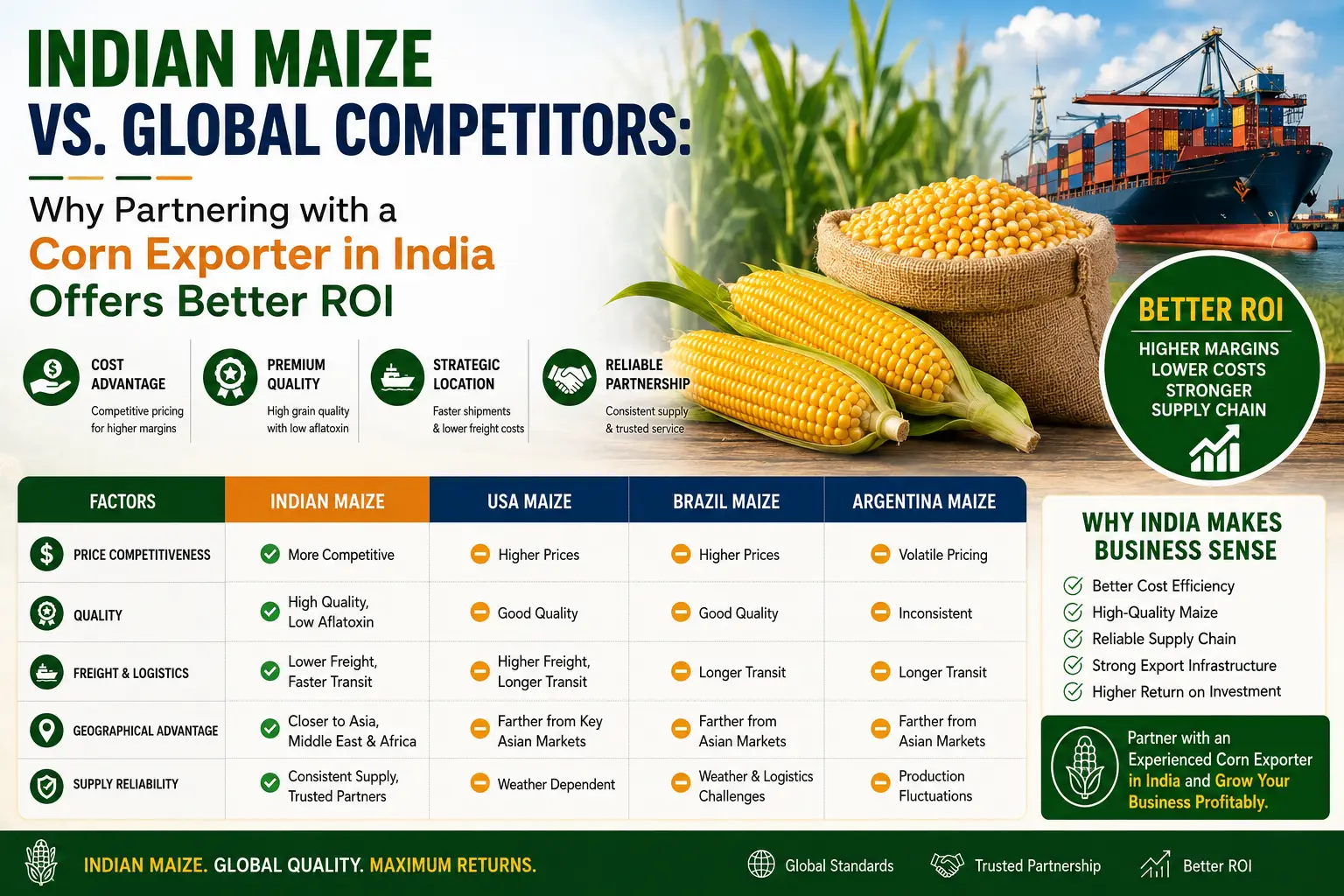
If your goal is better procurement ROI, partnering with a Corn Exporter India can be a practical choice when you need competitive pricing, buyer-specific specifications, and flexible shipment planning. For many importers, Indian maize is not simply an alternative origin; it is a supply option that can improve margin protection, reduce specification risk, and support more responsive sourcing.
What is a corn exporter in India? A corn exporter in India sources, cleans, grades, tests, packs, and ships maize for overseas buyers in feed, food processing, and industrial segments. The right exporter does more than move cargo; it helps buyers control moisture, purity, documentation, packaging, and dispatch coordination so the product performs as expected at destination.
That distinction matters because corn buying decisions are rarely won on FOB price alone. Senior buyers typically evaluate total landed cost, handling losses, process compatibility, supply continuity, and the administrative effort needed to keep shipments moving without disputes.
Why ROI Matters When Choosing a Corn Exporter India
In maize procurement, ROI comes from the full supply outcome, not just the invoice value. A lower quoted price can quickly lose its appeal if the cargo arrives with inconsistent moisture, excess foreign matter, weak bagging, or documentation gaps that slow customs clearance. Buyers who focus only on origin-level price comparisons often underestimate the operational cost of avoidable rework.
For feed mills and food processors, specification consistency has direct plant-level implications. If incoming corn varies too much in moisture or cleanliness, teams spend more time adjusting storage, screening material, or managing yield issues. That means production planning becomes less predictable, and procurement savings can disappear inside operating inefficiency.
Indian exporters are often attractive when buyers need a more hands-on supply relationship. Many global buyers do not want a one-size-fits-all commodity transaction; they want a supplier who can align with target grade, packing format, documentation requirements, and destination-market expectations. That responsiveness can materially improve purchasing efficiency even before the shipment leaves port.
For companies building multi-product sourcing from India, maize can also fit into a broader procurement strategy. Buyers already working with agri products exporters from India often prefer suppliers who understand cross-category export handling, because it simplifies vendor management and supports long-term sourcing continuity.
Indian Maize in the Global Market: How It Competes With Major Origins
Global maize buyers typically compare India with the USA, Brazil, Argentina, and other regional origins. Those markets are well established and often supply large-volume trade, but they are not always the best fit for every buyer. The right origin depends on your end use, acceptable variation, order size, shipment timing, and tolerance for long procurement cycles.
Indian maize tends to compete well when buyers prioritize commercial flexibility. Some importers need moderate-volume shipments, buyer-specific bagging, or closer coordination on loading and paperwork rather than purely standardized bulk trade. In such scenarios, a Maize Exporter India may be easier to work with than a supplier optimized mainly for very large commodity flows.
How does Indian maize compare with corn from the USA, Brazil, and Argentina? The answer is practical: major origins can be strong for scale and established trade routes, while India can offer better fit for buyers who value adaptable execution, customized packaging, and direct exporter support. This is especially relevant for importers supplying mixed customer bases across feed, food ingredients, and regional distribution.
For buyers that also need adjacent corn products, India offers another advantage: sourcing continuity across the processing chain. A supplier familiar with maize trading can also support related products such as corn export products and specifications, helping procurement teams reduce vendor fragmentation and align quality conversations under one relationship.
Price Advantage: How Indian Corn Improves Importer Margins
The real price advantage of Indian corn lies in total commercial efficiency. Importers should compare not only commodity price, but also bagging costs, quality claims exposure, inland coordination effort, and flexibility on shipment structures. A supplier that solves these issues can protect margins more effectively than a cheaper offer with higher execution friction.
Indian exporters can be particularly useful for buyers that do not purchase only in large vessel-scale programs. Smaller or phased buying strategies often need practical attention to lot planning, dispatch timing, and communication speed. When the supplier is willing to structure shipments around the buyer’s inventory cycle, working capital pressure becomes easier to manage.
What factors affect ROI when sourcing maize from India? The main ones are delivered cost, usable product yield, loading accuracy, claim risk, packaging suitability, and how quickly procurement issues are resolved. If an exporter responds clearly on these points before contract finalization, buyers gain a better basis for comparing offers across origins.
| Buying Factor | Commodity-Led Approach | ROI-Led Approach |
|---|---|---|
| Price comparison | Focus on headline FOB rate | Evaluate landed cost and handling impact |
| Quality review | Accept broad grade description | Check moisture, purity, and tolerance alignment |
| Packaging | Take standard option | Match bagging to storage and resale needs |
| Logistics | Buy on shipment promise | Review documentation and dispatch reliability |
| Supplier fit | Transactional selection | Assess responsiveness and issue resolution |
For senior decision-makers, that table captures the core shift: the best maize source is not the one that looks cheapest on paper, but the one that performs cleanly through contracting, shipment, receiving, and downstream use. That is where Indian origin can create better importer economics.
Quality, Purity, and Moisture Control in Export-Grade Indian Maize
Quality control is where many sourcing programs either stabilize or break down. Export-grade Indian maize should be assessed on moisture range, foreign matter control, damaged grain tolerance, grain uniformity, and suitability for the intended application. A serious exporter will discuss these factors openly and define them clearly in the commercial agreement.
For feed applications, consistency matters because formulation and storage behavior depend on incoming grain condition. For food processing, the focus may shift more toward cleanliness, appearance, and process suitability. In both cases, buyers should ask how the supplier handles cleaning, grading, lot segregation, and pre-shipment checks.
Can Indian corn exporters provide buyer-specific specifications? Yes, reputable exporters commonly work against destination-specific requirements, especially when the buyer states the intended use, moisture threshold, packing format, and inspection expectations early in the negotiation. This is one of the strongest reasons many buyers prefer a relationship-driven exporter over a purely volume-driven seller.
Buyers expanding beyond raw maize should also think about downstream compatibility. If your portfolio includes food ingredients, it helps to work with a supplier that understands adjacent categories such as corn flour and corn grits, because specification discipline in primary maize often carries into processed corn products used by cereal, snack, and ingredient manufacturers.
Logistics, Packaging, and Supply Flexibility for International Buyers
Logistics flexibility is one of the most underrated drivers of ROI in agricultural trade. Importers do not just buy product; they buy shipment readiness, container planning, documentation accuracy, and exporter responsiveness when schedules change. A dependable Indian supplier can reduce the operational burden on procurement, operations, and clearing teams.
Packaging matters more than many first-time buyers expect. The right bag size, bag strength, labeling format, and palletization approach can influence warehouse handling, retail redistribution, and product protection during transit. For distributors and processors, customized packing is often not a convenience feature; it is a cost-control measure.
Why should importers choose a corn exporter in India over other global maize suppliers? One important reason is that Indian exporters are often well suited to buyers who need a combination of bulk supply and practical customization. That includes private labeling support where relevant, buyer-specific markings, and coordination across product families for customers importing more than one staple commodity.
Buyers new to this route can strengthen execution by reviewing a structured import process before finalizing contracts. The guide on how to import premium Indian maize is useful for teams that want better clarity on shipment planning, documentation, and receiving preparation.
Best Use Cases for Indian Corn in Feed, Food Processing, and Industrial Applications
Indian maize is commonly purchased for feed manufacturing, where buyers value nutritional utility, commercial competitiveness, and supply flexibility. Poultry, cattle, dairy, and aquaculture feed operators often need dependable raw material that can fit formulation requirements without creating handling problems at plant level. In these use cases, clean grain and steady execution can matter as much as the base purchase price.
Food processing is another important use case, especially for milling and ingredient conversion. Buyers sourcing maize for flour, grits, starch, snack manufacturing, and cereal applications need grain that supports predictable processing behavior. A supplier who understands these end uses can better align grading and shipment preparation with commercial expectations.
What industries commonly buy corn from India for export? The main segments include feed manufacturers, grain traders, flour mills, starch producers, snack and breakfast cereal manufacturers, and industrial users requiring maize as an input. Buyers in these sectors often benefit when the exporter can also support related products such as corn flour for food processing and corn grits for cereals and snack manufacturing.
For integrated feed buyers, there is additional value in working with a supplier that can support complementary inputs. Where procurement teams source multiple feed ingredients, access to animal feed ingredients including Corn DDGS and Rice DDGS can simplify supplier coordination and create stronger long-term purchasing leverage.
Key Factors Buyers Should Evaluate Before Selecting a Maize Export Partner
Start with specification discipline. Ask the exporter to define product parameters in commercial language that can be written into the contract and verified before dispatch. Broad verbal assurances are not enough when your receiving team, warehouse operator, and production line all depend on the incoming lot performing to expectation.
Next, evaluate communication quality. Strong exporters answer practical questions quickly: what grade is available, how is the lot prepared, what packing options are possible, what documents will be issued, and how are disputes handled if cargo does not match agreed terms. A supplier’s response quality before the sale is usually a reliable indicator of support quality after shipment.
Operational buyers should also review consistency across lots, not just one sample or one offer. If the exporter cannot explain sourcing control, lot segregation, and pre-shipment checking, the buyer takes more quality risk than the quotation may suggest. The best partners make it easier for your procurement and quality teams to approve repeat business with confidence.
Finally, check whether the exporter can grow with your account. If your business may later source rice, sugar, salt, flours, or other staples, a multi-category exporter can become more valuable over time. That is one reason many buyers exploring broader Indian sourcing also review guides such as this overview of rice exports from India when building a longer-term vendor shortlist.
Why Partnering With Weltweit Agri Exports LLP Creates Long-Term Value
Weltweit Agri Exports LLP is positioned for buyers who want more than a transactional maize quote. As an agricultural exporter from India serving international markets, the company focuses on export-grade products, practical buyer support, customized packaging, and dependable logistics coordination. That matters for importers who need a supply partner that can adapt to end-use requirements rather than simply dispatch available stock.
For maize buyers, the value is in alignment: quality-focused sourcing, buyer-specific specifications, and the ability to support different commercial applications from feed to food processing. For procurement teams managing several staples, the relationship becomes even more useful because the company also works across a broader agri commodity range, helping reduce supplier complexity.
Weltweit Agri Exports LLP is especially relevant for buyers who want an Indian corn exporter for global buyers that understands practical export execution. That includes shipment planning, packaging flexibility, quality control expectations, and communication that helps overseas import teams move faster with fewer avoidable questions. In B2B commodity trade, those details shape long-term ROI.
If your business is reviewing supply options for maize, corn-based ingredients, or a wider basket of Indian agricultural products, now is the right time to start a direct specification discussion with Weltweit Agri Exports LLP. A clear origin comparison, backed by practical quality and logistics planning, is the fastest route to a sourcing decision that improves margin and reduces risk.
FAQ: Corn Exporter India for Global Buyers
Q: Why should importers choose a corn exporter in India over other global maize suppliers?
A: Importers often choose India when they need a balance of competitive pricing, specification flexibility, customized packaging, and responsive exporter communication. Indian suppliers can be especially effective for buyers who want commercial adaptability rather than only large standardized commodity flows.
Q: How does Indian maize compare in price and quality with corn from the USA, Brazil, and Argentina?
A: The comparison depends on shipment size, destination, end use, and contract terms. Major global origins may suit some bulk programs, while Indian maize can offer stronger ROI for buyers who value quality alignment, lot flexibility, and smoother exporter coordination.
Q: What industries commonly buy corn from India for export?
A: Common buyers include feed mills, livestock nutrition companies, grain traders, corn flour mills, starch producers, cereal manufacturers, snack processors, and industrial users that require maize as an input.
Q: Can Indian corn exporters provide customized packaging and buyer-specific specifications?
A: Yes. Reputable exporters often provide bag-size options, buyer markings, and specification-based shipment preparation, provided requirements are agreed clearly before contract execution.
Q: What factors affect ROI when sourcing maize from India?
A: Key factors include landed cost, usable quality, moisture control, packing suitability, shipment reliability, claim risk, and the amount of operational effort needed to manage the supply relationship.
Q: Is Indian maize suitable for both feed and food processing?
A: Yes, provided the grade is matched to the application. Feed buyers typically focus on nutritional and handling consistency, while food processors may place greater emphasis on cleanliness, grain uniformity, and process performance.
Q: What should buyers request before finalizing a maize export order?
A: Buyers should request clear product specifications, packing details, shipment terms, quality-check process information, and a complete list of export documents to avoid misunderstanding later in the transaction.
Related Articles
- How to Import Premium Indian Maize: A Step-by-Step Logistics Guide for Global Buyers
- Sourcing Premium Maize: The Ultimate Guide to Choosing a Corn Exporter in India
- Rice Exporter in India: A Complete Guide for Global Rice Buyers
- Agri Products Exporters from India | Premium Indian Agri Commodities
- Basmati Rice Exporter from India: How to Choose the Right Supplier for Global Rice Trade
- Peanut Exporter from India: How to Choose a Reliable Groundnut Supplier for Global Markets
Corn Exporter India: Better ROI Than Global Rivals
See why a Corn Exporter India can deliver better ROI through pricing, quality control, flexible packaging, and reliable supply.