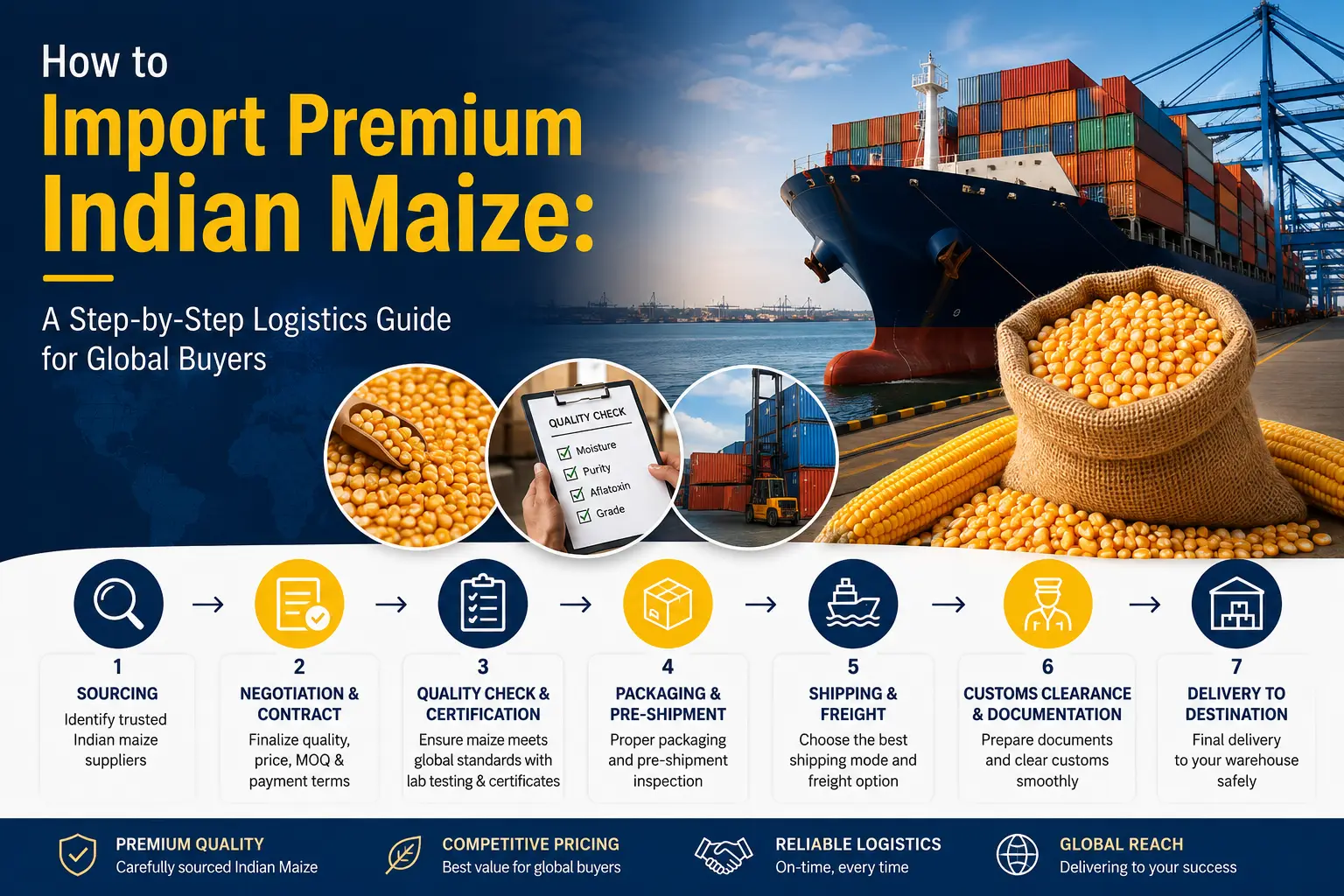
To import premium Indian maize successfully, buyers need more than a price quote. They need a reliable Corn Exporter India partner who can match the right maize grade to the intended use, confirm quality specifications before shipment, prepare compliant export documents, and manage packing and freight without avoidable delays.
Indian maize is widely sourced for animal feed, starch processing, food ingredients, and industrial use, but the import process must be handled with specification discipline. Buyers who define moisture limits, grain condition, packing format, discharge port requirements, and payment terms at the start usually avoid the disputes that happen when the order moves too quickly from inquiry to loading.
What is premium Indian maize? In export trade, premium Indian maize refers to cleaned, properly dried, graded corn supplied against agreed buyer specifications for color, foreign matter, moisture, damaged kernels, aflatoxin tolerance where applicable, and packing or bulk loading format. Premium does not mean one universal grade; it means the shipment consistently meets the importer’s exact commercial and technical requirements.
For buyers comparing suppliers, this article explains the real import workflow from first inquiry to final delivery. It is written for procurement teams, feed manufacturers, food processors, traders, and bulk ingredient buyers seeking structured guidance from a premium Indian corn supplier rather than generic commodity advice.
Why Global Buyers Source Premium Indian Maize
Global buyers source Indian maize because it serves multiple end uses across feed, food, and processing industries. Depending on the destination market, imported maize may be used in poultry and cattle feed, starch manufacture, corn flour, grits, snack processing, breweries, or other industrial applications. That is why the buying decision is rarely based on price alone; suitability for the intended application matters more.
India is relevant in global agri trade because it offers broad agricultural sourcing depth and flexible export packaging. Buyers working with Indian agricultural products suppliers often value the ability to combine commercial responsiveness with buyer-specific specifications, especially when they need containerized supply rather than only very large program volumes. This flexibility can be useful for mid-sized importers, regional distributors, and processors testing new supply channels.
Another practical reason buyers choose India is product range consolidation. Many importers who begin with maize later also buy feed ingredients, starches, flours, rice, sugar, salt, or oilseeds from the same exporter to simplify procurement. For companies looking beyond one shipment, a diversified agri exporter can reduce onboarding time and improve coordination across products.
Buyers who want broader sourcing context can review Agri Products Exporters from India to understand how maize fits into a larger agricultural products exporters portfolio. That broader capability matters when importers need a long-term supply partner rather than a one-product trader.
Why maize buying decisions differ by end use
A feed buyer and a food ingredient buyer may both ask for yellow corn, but their priorities are different. Feed buyers typically focus on nutrient consistency, moisture, damaged grain tolerance, contamination risk, and landed cost efficiency. Food processors may place greater emphasis on cleanliness, particle yield, processing behavior, and suitability for downstream products such as flour, grits, or starch.
This distinction is important because a quotation request that says only “maize required” is incomplete. A serious Maize Exporter India supplier will ask follow-up questions before confirming terms. That is usually a positive sign, not a delay tactic, because it reduces the chance of quality claims after arrival.
Define Your Maize Requirements Before Requesting a Quote
The strongest maize imports start with a precise purchase specification. Before asking for an offer, the buyer should define maize type, intended use, target quantity, packing preference, destination port, and required shipment window. If these basics are unclear, quotations from different exporters become impossible to compare fairly.
At a minimum, the request should mention whether the maize is for feed, food processing, starch extraction, or resale. It should also state whether the buyer needs yellow or white corn, container shipment or bulk format, and whether the shipment must comply with any destination-specific phytosanitary, fumigation, or labeling requirements. These are not small details; they affect sourcing, cleaning, packing, documents, and freight planning.
Buyers should also specify the commercial term they want quoted, such as FOB, CFR, or CIF. When the Incoterm is not stated, one exporter may quote ex-warehouse logic while another includes ocean freight assumptions, creating confusion at the negotiation stage. A clean inquiry leads to cleaner negotiations.
Weltweit Agri Exports LLP supports buyers seeking structured maize sourcing through its corn export product page, where maize sits within a wider export-grade commodity offering. Buyers looking specifically at supplier selection criteria can also read Sourcing Premium Maize: The Ultimate Guide to Choosing a Corn Exporter in India for a complementary evaluation framework.
Key details to include in your maize inquiry
- Grade and use: feed maize, food-grade maize, starch grade, or processing grade.
- Quality parameters: moisture, foreign matter, broken kernels, damaged kernels, mold tolerance, and test requirements.
- Quantity and frequency: one container, trial order, monthly program, or contract supply.
- Packing: bulk, jumbo bags, PP bags, or buyer-branded private packaging where applicable.
- Destination: discharge port, country-specific import rules, and preferred shipping terms.
When these points are defined early, the exporter can assess feasibility before issuing a commercial proposal. That reduces later amendments, vessel rollover issues, and documentary corrections that often happen when the buyer’s internal team finalizes technical details too late.
How to Evaluate a Reliable Corn Exporter India
A reliable Corn Exporter India should be evaluated on process discipline, not marketing claims. Buyers should examine whether the exporter asks the right specification questions, explains the quality confirmation process, provides realistic packing and loading options, and understands destination-market document requirements. Reliability in export trade is operational, not promotional.
Ask whether the supplier exports regularly or only trades opportunistically. A serious exporter will be able to explain how product is sourced, cleaned, stored, inspected, packed, and dispatched. They should also be able to discuss contingency planning for issues such as delayed truck arrival at port, container availability changes, or document amendments requested by the buyer’s bank.
It is also useful to test communication quality before placing the order. If the exporter responds vaguely to basic questions on moisture range, fumigation, packaging weight, or loading plan, that lack of precision may continue after payment. In contrast, exporters who clarify assumptions early tend to execute more predictably.
For buyers in East Asia who want a market-specific perspective, How to Identify the Best Corn Exporter in India for South Korean Buyers provides an additional lens on how to screen Indian suppliers for long-term maize trade.
Questions to ask before approving a supplier
Can the exporter supply against written specifications? The answer should include how quality is checked before dispatch and what documentation can support the shipment. Can they support repeat supply? One successful trial shipment is useful, but repeatability matters more for processors and feed mills.
Do they understand your end use? This is critical because feed buyers, flour millers, and starch users evaluate maize differently. Can they align with your logistics team? Smooth trade depends on coordination between procurement, documentation, freight, customs, and receiving operations.
Quality Standards, Testing, and Buyer Specifications to Confirm
Quality alignment is the heart of any maize import contract. Buyers should confirm all shipment specifications in writing before proforma invoice approval, including moisture, foreign matter, broken percentage, damaged kernels, infestation status, and any limits on mold or mycotoxin exposure depending on the destination market and end use. If the standard is not documented clearly, later disputes become subjective.
Pre-shipment inspection expectations should also be discussed in advance. Some buyers rely on the exporter’s internal quality check, while others appoint an independent inspection agency for weight, packing, and quality verification before loading. The correct approach depends on buyer risk policy, destination regulations, and financing method.
What specifications should buyers check before importing maize from India? Buyers should check moisture, grain uniformity, cleanliness, foreign matter, broken kernels, damaged kernels, color consistency, infestation status, packing quality, and any test parameters relevant to feed or food use. They should also confirm whether the shipment needs fumigation, phytosanitary certification, and lot traceability records.
For importers using maize as part of a wider feed formulation, quality review should not happen in isolation. Weltweit Agri Exports also serves buyers of animal feed ingredients supply solutions, which is relevant for importers balancing corn with DDGS or other feed materials in one sourcing program.
Food use versus feed use quality checks
Food and ingredient buyers often require tighter process control because downstream milling yield and hygiene standards affect finished products. If the maize will be converted into flour, grits, or starch, buyers should ask how cleaning and grading are managed before packing. Importers exploring maize-derived ingredients alongside other processing inputs may also review Weltweit’s broader starch and corn-based food ingredients exports capabilities.
Feed buyers should focus heavily on moisture management, contamination control, and consistency across lots. Even if the shipment meets contract terms on paper, poor lot uniformity can create formulation issues at the feed mill. That is why sample approval, specification sign-off, and loading supervision are commercially sensible for many buyers.
Packaging Options and Container Loading for Maize Exports
Packaging should be selected based on the buyer’s receiving infrastructure, storage conditions, and resale or processing model. Some buyers want bulk-style efficiency in large bags, while others need smaller bag formats for easier handling at destination warehouses. The exporter should recommend the most practical option after understanding the discharge setup.
How is Indian maize packed for international shipments? Common options include PP bags, customized bag sizes, jumbo bags, and containerized bulk-oriented packing depending on contract terms and the importer’s handling capacity. Packaging must protect the maize from moisture ingress, handling tears, and avoidable transit damage during inland movement and ocean transport.
Container loading discipline is just as important as bag choice. Containers should be checked for dryness, cleanliness, odor, structural integrity, and suitability before stuffing. A buyer who ignores container condition may receive a technically compliant shipment that still suffers from practical issues such as wet packaging, odor contamination, or uneven stowage.
The loading plan should also consider destination discharge efficiency. If the buyer’s warehouse has labor constraints or limited unloading equipment, packing and palletization decisions should reflect that reality. Good exporters discuss these practicalities before dispatch, not after the container is sealed.
| Buyer Need | Suitable Packaging Approach | Why It Matters |
|---|---|---|
| Feed mill with bulk handling focus | Jumbo bags or high-efficiency bulk packing format | Reduces handling complexity at discharge |
| Distributor selling into smaller channels | Standard bagged packing in manageable weights | Improves warehouse movement and resale flexibility |
| Food processor needing cleaner presentation | Well-sealed bagged packing with clear marks | Supports traceability and inspection on arrival |
| Buyer with private packaging requirements | Customized printed bags where commercially agreed | Aligns shipment with downstream market needs |
Export Documentation and Compliance for International Shipments
Documentation errors cause more disruption in agri exports than many first-time buyers expect. Even when product quality is acceptable, mistakes in invoice details, consignee information, certificate wording, shipping marks, or bill of lading instructions can delay customs clearance or bank negotiation. That is why document review should start before cargo loading, not after vessel departure.
What documents are required to import corn from India? The core set usually includes the commercial invoice, packing list, bill of lading, certificate of origin where needed, phytosanitary certificate when required by the destination, fumigation evidence if applicable, and any contract-specific inspection or quality certificate. The final set depends on the destination country’s import regulations, banking terms, and the buyer’s internal compliance policy.
Importers should also align document names and addresses exactly with customs registrations and letter of credit instructions where relevant. Small inconsistencies can create costly amendment cycles. A disciplined exporter will ask for consignee and notify details in writing and reconfirm them before shipping instructions are filed.
For buyers expanding procurement beyond maize into other staples handled by flour sugar salt and other essentials exporters, document standardization becomes even more important. Exporters with multi-commodity experience are often better positioned to manage varied certificate requests across food, feed, and ingredient shipments.
Compliance checks before shipment
Before approving shipment, buyers should confirm import permit requirements, phytosanitary rules, fumigation expectations, labeling rules, and whether any commodity-specific restrictions apply in the destination market. These requirements can vary significantly by country and by intended use. The exporter can support the process, but the importer should verify final admissibility with its customs broker or local authority.
Question: Can the exporter handle destination-specific documentation requests? Answer: a capable exporter usually can, provided the buyer communicates the requirements clearly and early. Last-minute requests after container gating often create avoidable stress and amendment costs.
Shipping, Freight Planning, and Delivery Timelines
Freight planning should begin at the quoting stage because the lowest commodity price is not always the best landed-cost option. Port choice, container availability, transshipment risk, sailing frequency, and destination congestion can all affect the final supply outcome. Buyers should ask for a logistics view, not only a product offer.
Indian corn export logistics typically involve inland movement from source to packing or stuffing point, customs processing, port handling, vessel loading, ocean transit, and destination clearance. At each step, communication matters. Procurement teams should know who is responsible for cargo readiness, booking confirmation, shipping instructions, original documents, and arrival notice coordination.
What affects delivery timelines most? Vessel schedule changes, port congestion, customs examination, inland trucking delays, late document approval, and destination clearance bottlenecks are among the most common factors. A reliable yellow corn exporter India partner will discuss likely timing ranges realistically instead of promising impossible delivery dates just to secure the order.
Buyers should also decide whether they prefer FOB control or a freight-inclusive structure such as CFR or CIF. Some importers have strong freight relationships and want booking control; others prefer the exporter to manage shipment coordination. The right answer depends on internal logistics capacity and risk appetite.
Cost Factors, Payment Terms, and Risk Management
Maize export pricing is shaped by more than raw commodity value. What factors affect maize export pricing and freight costs? Product grade, seasonality, inland transport distance, packing type, container availability, port charges, inspection scope, destination freight, and payment structure all influence the final offer.
Buyers should compare offers on a like-for-like basis. If one supplier quotes lower but excludes fumigation, inland haulage, quality testing, or destination-relevant packing, the comparison is misleading. Every quotation should be checked against the same specification sheet and the same Incoterm.
Payment terms should align with the trust level and order stage. Trial orders often use conservative payment structures, while repeat business may move to more flexible arrangements once performance is proven. Importers should also define claim procedures in the contract, including how shortages, visible packing damage, or quality disputes will be documented and reviewed.
Risk management is strongest when expectations are documented, samples are approved where needed, documents are reviewed before issuance, and the shipment is inspected at the right stage. Commodity trade always carries operational risk, but disciplined contracting reduces ambiguity. For long-term buyers, exporter reliability often delivers more value than chasing the cheapest one-time offer.
Step-by-Step Import Process From Inquiry to Final Delivery
The most efficient way to import Indian maize is through a structured sequence. First, send a complete inquiry with specifications, quantity, packing, destination, and target shipment period. Second, review the commercial offer carefully and confirm all quality and document requirements before approving the proforma invoice.
Third, align on sample approval or pre-shipment inspection if your policy requires it. Fourth, confirm packaging format, shipping marks, and booking details well before cargo readiness. Fifth, review the draft shipping documents before final issuance so customs and banking discrepancies are caught early.
Sixth, track vessel departure, document dispatch, and estimated arrival with your customs broker informed in advance. Seventh, inspect cargo condition and documentation at destination promptly, and report any issues according to the contract procedure. This workflow sounds basic, but many import delays happen because one of these steps is rushed or skipped.
Buyers seeking a dependable partner for bulk maize export from India should look for exporters that combine product knowledge, clear documentation control, flexible packing, and practical logistics support. Weltweit Agri Exports LLP positions itself as a trusted agri exporter from India for buyers who need export quality agricultural products, responsive communication, and reliable execution across maize and other food and feed commodities.
FAQ: Importing Maize from India
Related Articles
- Sourcing Premium Maize: The Ultimate Guide to Choosing a Corn Exporter in India
- Rice Exporter in India: A Complete Guide for Global Rice Buyers
- Agri Products Exporters from India | Premium Indian Agri Commodities
- How to Identify the Best Corn Exporter in India for South Korean Buyers
- How to Identify the Best Corn Exporter in India for South Korean Buyers
- A Practical Buyer’s Guide to Corn from INDIA
How to Import Indian Maize | Corn Exporter India
Learn how to import premium Indian maize with this step-by-step logistics guide from a trusted Corn Exporter India.