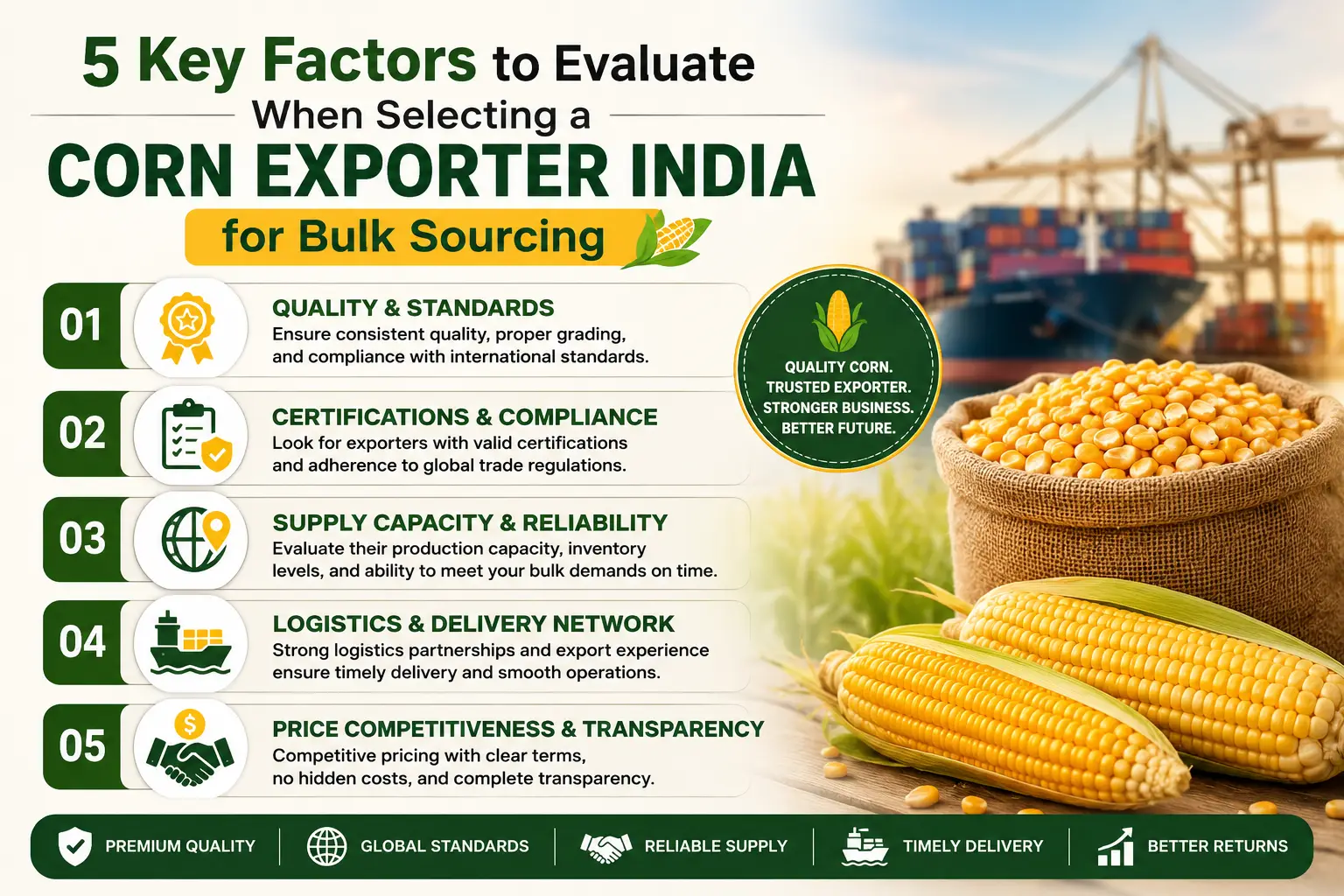
Selecting the right Corn Exporter India partner comes down to five practical checks: measurable grain quality, export compliance, supply consistency, packaging flexibility, and logistics execution. Buyers importing bulk maize for feed, starch, flour, grits, or food processing should verify these points before negotiating price, because shipment failures usually come from weak quality control or poor shipment planning rather than the commodity itself.
In B2B trade, a Corn Exporter India supplier is not just a trader; it is a supply-chain manager responsible for quality stability from origin to discharge port. This distinction matters because Indian corn serves different end uses. A feed buyer may prioritize protein, moisture, and aflatoxin risk, while a starch processor focuses on uniform grain, cleanliness, and yield performance. Buyers comparing Indian agro exporters often also source parallel categories such as flour, sugar, salt, and other essentials, so process discipline across commodities is a useful signal of reliability.
Why Choosing the Right Corn Exporter in India Matters
India is a major producer of non-GMO maize, giving Indian origin a strategic advantage for buyers selling into markets with strict GMO controls or brand-sensitive food chains. According to the Agricultural and Processed Food Products Export Development Authority (APEDA), maize remains an established export commodity from India, with volumes moving according to domestic pricing and global supply conditions. For many importers, the appeal is access to non-GMO origin with broad industrial and feed applications.
Procurement teams should understand Indian crop seasonality. Kharif corn is commercially viable, but the Rabi crop is often preferred for export programs because it typically offers lower moisture and better storage stability. An exporter that understands seasonal sourcing can advise whether a shipment should be booked immediately, blended carefully, or delayed for better quality availability.
The real commercial risk in bulk corn is whether the exporter can maintain specification integrity through drying, storage, stuffing, transit humidity, and destination clearance. A low-cost broker may quote aggressively but fail on moisture drift, infestation, or slow document release during vessel deadlines. This is why buyers increasingly favor structured agricultural exporters over spot-market intermediaries. For broader context on how Indian suppliers position agricultural commodities globally, the article Agri Products Exporters From India gives a useful overview of the export ecosystem.
Factor 1: Product Quality Standards and Moisture Control
Quality evaluation must start with contract-grade parameters. Ask the exporter to define moisture, foreign matter, damaged kernels, broken kernels, admixture, infestation status, and test weight in writing. If the supplier cannot state a shipment specification sheet before price discussion, that is an immediate concern.
For most bulk buyers, moisture is the first control point because it affects storage life, mold risk, and cargo claims. Indian maize quality is heavily influenced by harvest timing and post-harvest drying discipline, so the exporter should explain how lots are selected, dried, and stored before loading. A professional answer will include target moisture range and procedures for rejecting non-conforming lots.
Aflatoxin control is not optional
Serious buyers should ask a direct question: What are the guaranteed maximum moisture and aflatoxin levels for the shipped corn? The right answer should be tied to contract specification and destination-market tolerance. If your market requires aflatoxin under 20 ppb, state that requirement explicitly and require pre-shipment testing from a recognized laboratory or surveyor.
Tropical transit conditions can quickly degrade corn if packing, ventilation, and moisture management are weak. Exporters should be able to explain lot segregation, warehouse hygiene, loading-day checks, and container protection measures. These controls matter even more when corn is bought for food processing, starch, grits, or flour instead of lower-spec feed channels.
Buyers sourcing multiple maize derivatives should evaluate whether the supplier can support category continuity beyond raw grain. Weltweit Agri Exports serves buyers looking for a corn export product page reference and sourcing guidance as well as downstream ingredients such as a Corn Flour supplier from India, which is relevant when the same importer manages both grain and processed maize procurement.
Factor 2: Export Experience and Market Compliance Capability
Export experience is about destination-market execution. A dependable Maize Exporter India partner should understand phytosanitary requirements, fumigation expectations, certificate workflows, labeling, and port documentation needed by your country. Compliance mistakes create demurrage, inspection delays, and rejected cargo, even when the grain itself is acceptable.
Buyers should ask whether the exporter can provide third-party inspection before loading. Coordination should be available through independent agencies such as SGS or Intertek if required by contract. An exporter that welcomes third-party verification usually has stronger internal controls than one that resists outside inspection.
Questions to ask before issuing a purchase order
Can the exporter provide third-party quality certifications prior to loading? The supplier should confirm whether pre-shipment inspection, weight verification, sampling, and sealing can be witnessed and documented. What documents are issued? At minimum, discuss commercial invoice, packing list, bill of lading, certificate of origin, phytosanitary certificate, fumigation certificate, and inspection certificate.
India’s export framework is shaped by regulatory and trade procedures managed through bodies such as the Directorate General of Foreign Trade (DGFT). For commodity market context, the Multi Commodity Exchange of India (MCX) is useful for understanding price sensitivity and domestic market signals that can affect execution timing. Exporters that follow these dynamics quote more realistically and manage contracts more responsibly.
Factor 3: Bulk Supply Capacity and Consistent Availability
A buyer needs a supplier that can match the purchase program with consistent access to the right origin, lot size, and loading schedule. Ask how the exporter manages procurement across crop seasons and whether supply comes from a single state or multiple sourcing zones.
According to APEDA and official agriculture references, India’s annual maize production has crossed 35 million metric tonnes, supported by major producing states such as Karnataka, Madhya Pradesh, and Bihar. Large national output is helpful, but what matters is the exporter’s ability to aggregate usable lots that meet your exact specification.
Ask whether the corn is intended for feed, starch, grits, or human consumption channels. Dual-use sourcing capability is a meaningful differentiator because an animal feed corn supplier India must optimize around nutritional consistency and cost efficiency, while a starch buyer typically wants cleaner and more uniform grain.
Buyers should also ask how the exporter handles contract rollovers during market volatility. An experienced bulk corn supplier India will discuss replacement sourcing, shipment window planning, and communication protocol if domestic procurement becomes tight. This is particularly important when export flows fluctuate depending on price and policy conditions, as reported by APEDA.
Factor 4: Packaging Flexibility and Buyer-Specific Specifications
Packaging should match your intake system, not the exporter’s convenience. A processor receiving by conveyor may prefer jumbo bags or bulk handling, while a distributor may require PP bags with clear weight marking and pallet configuration. If the exporter cannot adapt packing format, unloading cost and contamination risk increase at destination.
Ask a direct operational question: Does the exporter offer bulk vessel loading, PP bags, or jumbo bags to match our facility? A qualified supplier should discuss bag strength, stitching, liner options, loading pattern, weight tolerance, and container optimization. This is especially important for buyers running both raw maize and processed product lines such as corn flour or grits.
Packaging is also a quality-control decision
Packaging affects cargo condition during long transit to Asia, Africa, Europe, or the Middle East. Moisture migration, bag damage, and poor container stuffing can create claims even when pre-dispatch testing was satisfactory. Exporters should explain how they use clean containers, dunnage, moisture protection, and loading supervision to reduce these risks.
Importers expanding beyond grain often look for a supplier that can support adjacent maize categories with the same packaging discipline. Buyers exploring processed maize can compare sourcing pathways through Weltweit Agri Exports’ educational content, including How to Identify the Best Corn Exporter in India for South Korean Buyers, which adds useful procurement checkpoints that apply globally.
| Evaluation Area | What Strong Exporters Provide | What Buyers Should Request |
|---|---|---|
| Quality specification | Defined moisture, foreign matter, damage, purity, and aflatoxin parameters | Written contract specs and pre-shipment test reports |
| Compliance | Experience with phytosanitary, fumigation, origin, and inspection documents | Document checklist by destination country |
| Supply capacity | Seasonal sourcing plan and lot aggregation capability | Loading schedule and monthly availability |
| Packaging | PP bags, jumbo bags, or bulk options with buyer-specific marking | Packing samples and loading configuration |
| Logistics | Port planning, survey coordination, and shipment tracking | ETA commitments and disruption response plan |
Factor 5: Logistics Support, Documentation, and Timely Shipment
Logistics capability is where many corn contracts succeed or fail. Bulk buyers should ask how the exporter manages vessel schedules, container bookings, survey coordination, port cut-offs, and document release timelines. A supplier that treats logistics as an afterthought can turn a competitively priced contract into a costly supply interruption.
Why is logistics capability important when selecting a corn exporter in India? Because maize is sensitive to delay, handling quality, and weather exposure. If containers sit too long before sailing or documents are not released in sequence, the buyer may face warehouse disruption, production stoppage, or avoidable storage claims.
Ask another direct question: How does the exporter manage supply chain disruptions during peak port congestion seasons in India? Good answers include alternate port planning, earlier cargo positioning, buffer time in stuffing schedules, proactive shipping-line coordination, and regular status reporting. Weak answers focus only on “best effort” without defining who monitors each milestone.
Documentation discipline matters just as much as freight execution. The exporter should know which originals, scans, legalization requirements, and certificate timings are needed by banks, customs brokers, and destination authorities. For buyers managing cross-category imports, this level of process control is what separates a trusted agri exporter from a commodity broker.
Red Flags to Watch for When Comparing Indian Corn Exporters
The first red flag is an exporter who quotes quickly but avoids discussing specification tolerances. If a seller keeps saying “best quality” without defining moisture, admixture, or aflatoxin limits, you do not yet have a commercial offer. Bulk sourcing requires measurable quality, not adjectives.
The second red flag is resistance to third-party inspection or refusal to share sample reports. Professional suppliers understand that importers need objective proof before loading. If the exporter is uncomfortable with independent testing, buyers should question lot consistency and traceability.
The third red flag is overpromising on shipment windows without showing a logistics plan. During heavy export periods, execution depends on container access, stuffing coordination, and documentation speed. A supplier that guarantees unrealistic ETDs to win the order may create larger downstream losses for the buyer.
The fourth red flag is narrow capability. If the exporter can only discuss spot cargo and cannot explain market compliance, packaging alternatives, or end-use grading, it may not be the right fit for a serious annual program. Corn procurement is safer when the exporter thinks in systems rather than one-off transactions.
How Weltweit Agri Exports LLP Supports Global Bulk Corn Buyers
Weltweit Agri Exports LLP positions itself as a practical sourcing partner for buyers who need export quality agricultural products from India with clear documentation and responsive execution. The company serves international markets across Asia, Europe, Africa, and beyond, with experience in food commodities, feed ingredients, and customized packaging formats. That broader portfolio helps buyers who prefer to consolidate agricultural sourcing through one reliable exporter.
For corn buyers, that means support around specification-based procurement, packaging flexibility, and export documentation rather than generic commodity trading. Weltweit also serves adjacent categories relevant to maize buyers, including feed ingredients and grain-based exports, which is useful for importers managing multiple SKUs and coordinated shipment schedules. Buyers already importing cereals may also review Weltweit’s wider grain capabilities through its Indian Rice page when building multi-commodity supply programs.
The strongest reason to shortlist Weltweit is process alignment. Global buyers need a supplier that understands the difference between food-grade expectations, feed-industry tolerances, and industrial processing requirements. A dependable exporter should be ready to discuss testing, packaging, loading, and destination documentation in the same conversation, because those details determine landed performance.
If you are evaluating an Indian corn exporter for recurring bulk sourcing, use the five factors in this guide as a supplier scorecard and compare answers line by line. Weltweit Agri Exports LLP is well positioned for buyers seeking a trusted agri commodities exporter from India that values quality control, transparent communication, and shipment reliability over one-time transactional quoting.
FAQ: Corn Exporter India for Bulk Buyers
Q: How do I choose a reliable corn exporter in India?
A: Start with measurable criteria: written quality specifications, pre-shipment testing, export documentation capability, packaging options, and a defined logistics plan. Reliable exporters answer technical questions clearly and support third-party inspection when requested.
Q: What quality parameters should I check before importing corn from India?
A: Review moisture, foreign matter, broken kernels, damaged kernels, purity, infestation status, test weight where relevant, and aflatoxin limits. The exact specification should match your end use, whether feed, starch, flour, grits, or direct food processing.
Q: Can Indian corn exporters provide bulk packaging and private labeling?
A: Many can provide PP bags, jumbo bags, and in some cases bulk loading formats, depending on shipment structure and destination handling requirements. Private marking on bags is commonly possible when discussed before production and loading.
Q: What documents are required when sourcing corn from India for export?
A: Common documents include commercial invoice, packing list, bill of lading, certificate of origin where required, phytosanitary certificate if applicable, fumigation certificate where relevant, and inspection certificate if specified by the buyer or destination rules.
Q: Why is logistics capability important when selecting a corn exporter in India?
A: Corn quality can deteriorate when stuffing, sailing, or document release is delayed. Strong logistics control helps reduce risk from port congestion, moisture exposure, missed cut-offs, and customs clearance issues at destination.
Q: Can exporters provide third-party quality certification before loading?
A: Yes, professional exporters typically can coordinate independent inspection agencies such as SGS or Intertek, depending on buyer requirement and shipment terms. Buyers should specify this requirement in the contract stage, not after cargo positioning.
Q: Is Indian corn suitable for both feed and industrial processing?
A: Yes, but suitability depends on grading and specification discipline. Feed buyers and starch or flour processors often require different quality priorities, so exporters should classify lots according to the intended application.
Q: What makes non-GMO Indian maize attractive in international trade?
A: Indian origin is often preferred by buyers serving markets or brands that want to reduce GMO contamination risk. This is particularly relevant for food and feed programs that require tighter sourcing control and documented supply-chain assurance.
If your procurement team is comparing suppliers for recurring corn contracts, shortlisting should be based on specification control, inspection readiness, packaging fit, and shipment reliability. Use these factors to assess potential partners carefully, and engage Weltweit Agri Exports LLP when you need an export-focused supplier that understands bulk maize trade beyond the quote stage.
Related Articles
- Sourcing Premium Maize The Ultimate Guide To Choosing A Corn Exporter In India
- How To Identify The Best Corn Exporter In India For South Korean Buyers
- How to Identify the Best Corn Exporter in India for South Korean Buyers
- Top 5 Reasons India Corn Exporter Indonesia
- Rice Exporter In India
- Agri Products Exporters From India
5 Factors to Choose a Corn Exporter India
Evaluate a Corn Exporter India partner by quality, compliance, packaging, and logistics for safer bulk corn sourcing.
<div style="display:flex;flex-wrap:wrap;gap:1