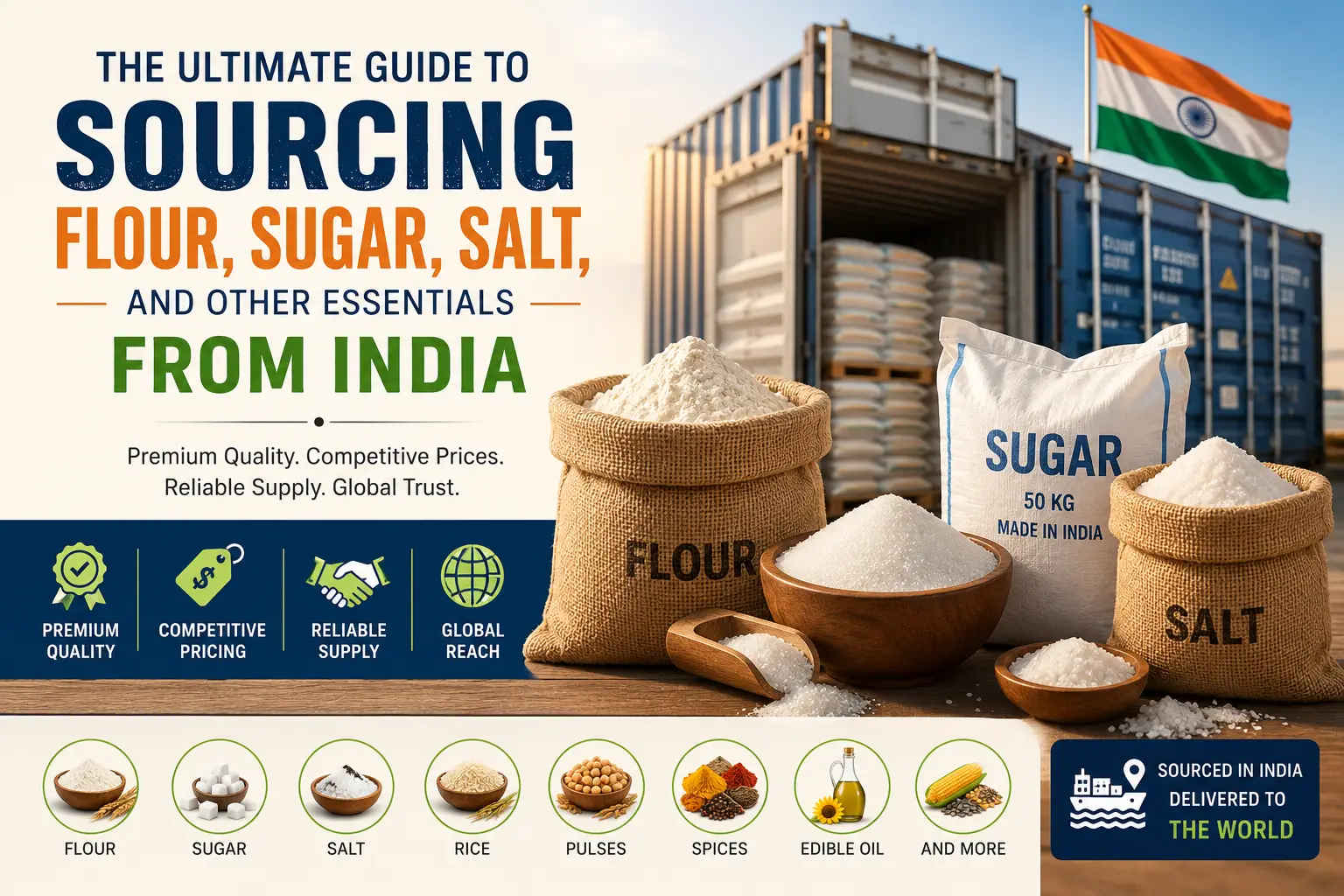
If you are evaluating flour sugar salt and other essentials exporters, India is a highly practical sourcing origin for international buyers needing product range, scalable supply, and flexible packaging. Sourcing from a single, reliable Indian exporter reduces vendor fragmentation, simplifies mixed-container buying, and improves consistency across pantry staples like flour, sugar, salt, starch, pulses, millets, and spices.
An essentials exporter is a B2B partner that sources, processes, packs, documents, and ships staple ingredients to buyer specifications. For procurement teams, this provides operational control over specification, compliance, labeling, and freight planning. Buyers can also consolidate complementary categories through a single agri commodities exporter India, including Basmati and non-Basmati rice, flours and starch, and sugar and salt, lowering landed costs without expanding the supplier base.
Why India Is a Strategic Source for Food Essentials
India’s strength in staple exports lies in domestic agricultural depth combined with industrial-scale milling, refining, and port connectivity. This setup supports both high-volume commodity buying and specialized requirements like high-protein wheat flour, fine icing sugar, iodized free-flow salt, chickpea flour, and custom starch grades.
Instead of sourcing flour, sugar, and salt from separate countries, buyers can consolidate multiple SKUs under one commercial relationship. This is highly efficient for regional distributors, private-label importers, and food manufacturers requiring repeat replenishment. According to ISMA, India’s integrated sugar industry regularly exports over 6 million metric tonnes annually. For salt, the Salt Commissionerate notes that India is the world’s third-largest producer, exporting to over 120 countries. Additionally, Expert Market Research projects the global wheat flour market to reach USD 210 billion by 2028, making India a key global food ingredient supplier.
How International Buyers Should Evaluate Exporters
The best supplier is rarely the cheapest. Senior buyers must evaluate whether an exporter can repeatedly deliver the exact specification, documentation, packaging, and shipment schedule required. Food trade issues usually arise from mismatches on moisture, granulation, labeling, or customs paperwork rather than initial product price.
Evaluate suppliers on four core criteria: category competence (retail, industrial, or foodservice grade), specification control (aligning ash, mesh size, ICUMSA, purity, and moisture), packaging flexibility, and responsiveness.
Questions to ask before approving a supplier
How do I choose a reliable Indian exporter? Ask for recent product specs, packaging options, lead times, and their standard export document pack. Inquire about their quality check processes and mixed-container support. Experience with markets like the UK, EU, GCC, Africa, or Southeast Asia is a strong indicator of reliable execution.
Can one supplier cover adjacent categories? Yes. An exporter that handles flour, sugar, and salt along with rice exports for global buyers, corn and maize sourcing, spices, pulses, and feed ingredients can greatly simplify replenishment planning and reduce administrative overhead.
Understanding Product Categories and Commercial Differences
Staples vary in storage, processing, and retail performance. Wheat, millet, rice, and chickpea flours differ in particle size, protein, fat, and moisture sensitivity. Sugar grades are distinguished by crystal size and color, while salt ranges from refined iodized to industrial grades.
For flour buyers, bakery applications require specific protein and gluten performance, while household use prioritizes freshness. Gluten-free and traditional flours like ragi, bajra, jowar, rice flour, and chickpea flour (besan) need precise grinding profiles. For sugar, the ICUMSA rating is key; lower values indicate higher refinement, which is critical for beverage, confectionery, and pharmaceutical buyers who need ICUMSA 45 or grades like S30, M30, or L30.
| Category | What buyers should specify | Typical commercial concern |
|---|---|---|
| Flour | Protein, ash, mesh, moisture, pack size | Shelf life, caking, bakery performance |
| Sugar | ICUMSA, crystal size, moisture, color | Application fit and pricing |
| Salt | Iodized/non-iodized, purity, granule size, free-flow | Clumping, food vs industrial use |
| Starch | Source, viscosity, moisture, modification type | Process consistency in food or industry |
| Pulses/Millets | Size, split/whole, polish, moisture, impurities | Cooking behavior and shelf stability |
Importers can expand their sourcing to include starch and specialty flours, Indian rice, and spices like cumin and sesame through the same exporter to optimize freight utilization.
Quality, Certifications, and Export Documentation
Quality control is a contract discipline. Buyers should request detailed product specs before sampling and ensure parameters like moisture, purity, foreign matter, granulation, ash, and microbiological limits are listed. A reliable food ingredients supplier India will align these details with proforma invoices and final shipping documents.
Key certifications include HACCP, ISO 22000, and FSSAI compliance. For regulated destinations, the exporter must issue batch-linked documents and coordinate inspections smoothly. For official trade guidance, buyers can refer to APEDA and the Ministry of Commerce and Industry.
Which documents are usually required?
Buyers should expect a commercial invoice, packing list, certificate of origin, phytosanitary or health certificates, fumigation details, and product analysis reports. Importers to the UK, EU, and Middle East must confirm destination-specific labeling, shelf-life marking, and commodity codes before vessel booking.
What quality specifications should international buyers check before importing? For flour, check protein, ash, and moisture. For sugar, verify ICUMSA and crystal consistency. For salt, confirm purity, iodine status, and anti-caking treatment. These factors directly impact manufacturing outcomes, storage life, and customs clearance.
Packaging, Private Labeling, and Container Planning
Packaging is a vital risk-control tool. In humid markets, flour and sugar require robust moisture protection. Buyers should select woven PP bags with liners, laminated packs, retail pouches, or multiwall paper based on destination climate and handling conditions.
What are the differences in shelf-life and moisture-control packaging options for flour and sugar? Flour is highly sensitive to odor pickup, fat oxidation, and moisture ingress. Sugar is prone to lumping under high humidity. Professional exporters address this with specialized inner liners, sealed retail packs, and proper palletization.
Private labeling is a major trend. Importers frequently request 1 kg to 50 kg configurations with custom artwork, barcodes, multilingual labels, and customized outer cartons. Sourcing direct from an exporter reduces destination-port repacking costs and speeds up brand launches.
Can Indian exporters consolidate customized private-label retail packs into one container? Yes. Mixed-container programs can combine flour, sugar, salt, spices, and other staples under one shipment. This is highly beneficial for distributors buying from an Indian sugar and salt exporter, an exporter of flour and starch, or a supplier of spices, peanuts, and animal feed ingredients.
Shipping Reliability, Common Mistakes, and Why Buyers Should Act Now
Bulk staple imports succeed when production timing, container planning, and document accuracy are aligned. Buyers should confirm lead times, minimum order quantities, and whether the exporter supports consistent repeat schedules rather than just one-off spot deals.
Key shipping factors include port access, container availability, transit times, and moisture-safe stuffing practices. When consolidating multiple pantry essentials, request a detailed container plan by SKU, pack size, and weight before confirming the order.
Common mistakes include buying solely on price, approving samples that don’t match final commercial specs, and underestimating climate impacts on packaging. Splitting related categories across too many suppliers also increases document handling and freight inefficiency. A trusted agri exporter from India simplifies this process.
Securing a capable Indian export partner early allows buyers to standardize specifications, streamline replenishment, and expand into adjacent categories with less friction. Weltweit Agri Exports LLP supports international buyers with premium-grade staples, custom packaging, and efficient multi-category sourcing.
FAQ
Q: How do I choose a reliable Indian exporter for flour, sugar, salt, and staple food ingredients?
A: Evaluate their technical specifications, documentation readiness, packaging flexibility, and communication. Ensure they have experience in your target market and the capability to handle mixed-container shipments.
Q: What quality specifications should international buyers check before importing flour, sugar, or salt from India?
A: Check protein and ash for flour; ICUMSA rating and crystal size for sugar; and purity, iodine content, and granule size for salt.
Q: Can Indian exporters provide customized packaging and private-label options for essential food products?
A: Yes, many exporters offer private labeling in packaging sizes ranging from 1 kg to 50 kg, tailored to retail and wholesale requirements.
Q: What documents and certifications are usually required when sourcing food essentials from India?
A: Standard documents include a commercial invoice, packing list, certificate of origin, and laboratory analysis reports. Phytosanitary and fumigation certificates are also required for many destinations, alongside ISO 22000 or HACCP certifications.
Q: Which shipping and logistics factors matter most when importing bulk food ingredients?
A: Focus on container stuffing quality, moisture protection, lead time reliability, and accurate documentation to ensure smooth customs clearance.
Q: Why work with Weltweit Agri Exports LLP for essentials sourcing from India?
A: Weltweit Agri Exports LLP provides a comprehensive export portfolio, including flour, starch, sugar, salt, rice, spices, millets, and animal feed. This allows buyers to consolidate vendors, customize packaging, and optimize shipping logistics.
If you are reviewing suppliers for essential agricultural staples, prioritize partners with proven specification control and compliance discipline. Weltweit Agri Exports LLP is ready to support your long-term sourcing needs.
Related Articles
- Sourcing Premium Maize: The Ultimate Guide to Choosing a Corn Exporter in India
- Navigating Sugar Export Regulations: Your 2026 FAQ Guide
- How to Succeed in Private Label Sugar Exports: A 2026 Guide
- 5 Key Factors to Evaluate When Selecting a Corn Exporter in India for Bulk Sourcing
- Sugar Salt
- Flours Starch
Flour Sugar Salt and Other Essentials Exporters Guide
Practical guide to flour sugar salt and other essentials exporters from India, covering specs, packaging, compliance and logistics.
“}