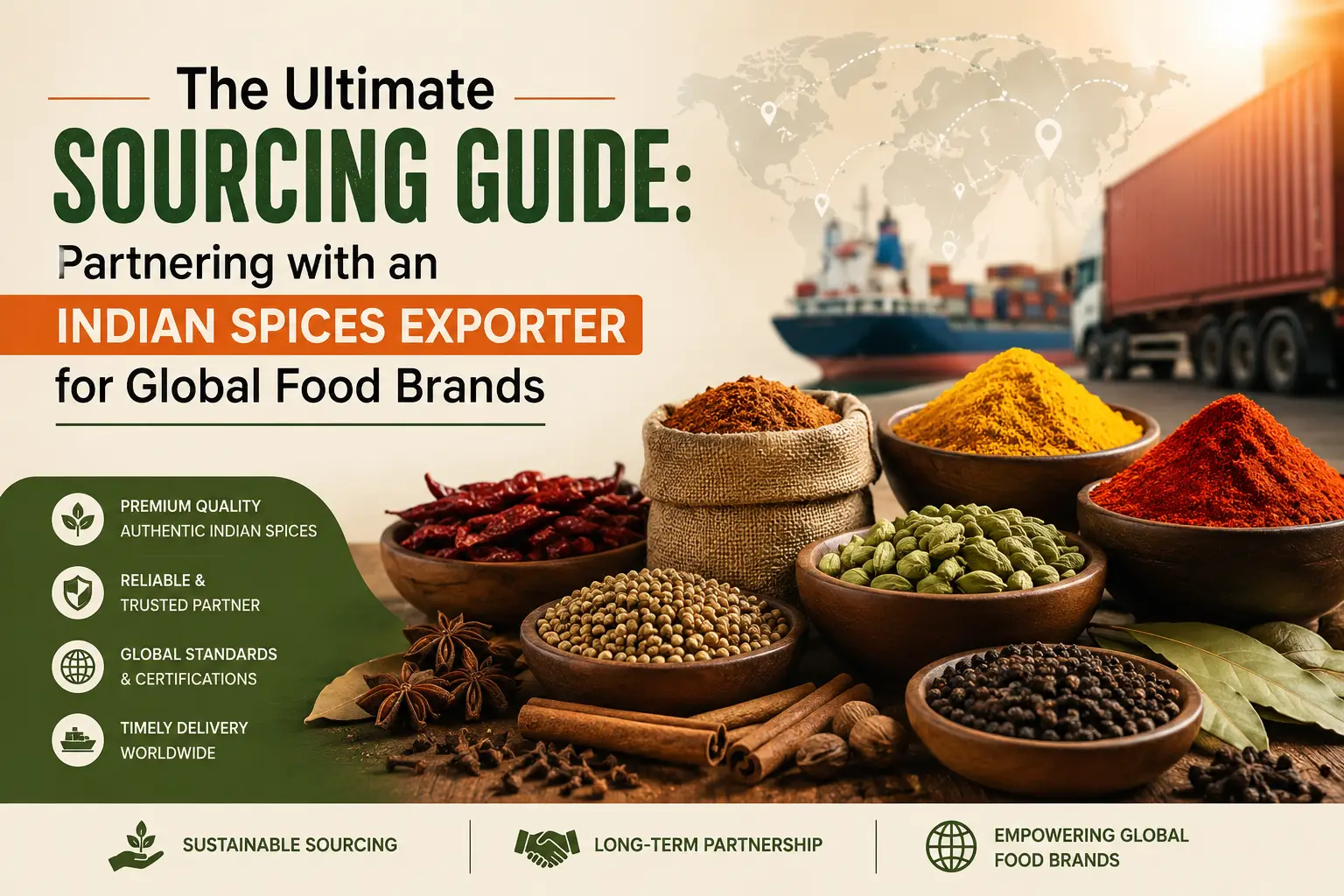
Selecting an Indian Spices Exporter for a food brand, importer, or ingredient distributor requires more than checking product availability. You need verified quality systems, destination-market compliance, custom processing, and reliable logistics. For buyers in Armenia, Georgia, Hong Kong, Indonesia, Japan, Jordan, Kuwait, Malaysia, and Papua New Guinea, India remains the most practical sourcing origin when the exporter combines origin strength with export discipline.
An Indian spices exporter sources, cleans, processes, tests, packs, and ships spices for overseas industrial, foodservice, retail, or private-label buyers. The best exporters act as compliance partners, not just traders.
Why global food brands source spices from India
India has scale, crop diversity, and processing depth that few origins can match. According to Spices Board India, the country exported 1.4 million tonnes of spices valued at USD 4.25 billion in FY 2023-24. India is the worldu2019s largest producer, consumer, and exporter of spices, accounting for nearly 46% of global spice trade by volume. Importers can source cumin, chilli, turmeric, coriander, black pepper, sesame, and blended requirements from one origin rather than managing fragmented procurement across multiple countries.
Regional specialization is another advantage. Gujarat and Rajasthan are central to cumin and coriander supply, while Andhra Pradesh and Telangana are key chilli-growing belts. Buyers who need export quality Indian spices with specific essential oil content, moisture parameters, or particle size prefer an origin with multiple producing regions to improve blending and grading options.
There is also a market-growth reason to build reliable supplier relationships now. According to Grand View Research, the global spices and seasonings market was valued at USD 22.06 billion in 2023 and is projected to expand at a 5.7% CAGR from 2024 to 2030. Direct relationships with a trusted agri exporter from India help protect availability and improve planning.
What an Indian Spices Exporter should offer beyond supply
Global buyers need exporters that prove control, not just quote a price. A serious spices exporter from India must explain sourcing regions, cleaning steps, metal detection, moisture control, allergen handling, batch coding, and pre-shipment testing. For regulated markets such as Japan and South Korea, traceability and residue control are deal-breakers.
Food brands expect baseline alignment with food safety systems such as HACCP, ISO 22000, GMP, Halal, or Kosher. Depending on the destination, buyers may also ask about FSSC-aligned procedures, microbiological testing, or ETO-free steam sterilization. According to APEDA and FIEO, export readiness depends on documentation, packaging compliance, and shipment execution.
What services reduce procurement risk?
Direct sourcing from verified exporters helps reduce volatility caused by weather disruptions, local mandi swings, and container delays. For buyers in Hong Kong, Malaysia, Indonesia, and Kuwait, a Mumbai-based exporter can optimize shipment planning by consolidating spices with other staples such as rice, sugar, salt, or flour. If your business sources essentials beyond spices, see Weltweitu2019s guide to flour, sugar, salt, and other essentials from India.
Weltweit Agri Exports LLP is positioned well for this multi-commodity model because it serves as a global food ingredient supplier across spices, grains, oilseeds, and staples. Buyers that want fewer suppliers and cleaner shipment coordination find this structure more efficient than negotiating separate contracts for each category.
Key spice categories and specification priorities for international buyers
A restaurant distributor in Jordan may prioritize aroma and visual consistency, while a seasoning manufacturer in Japan focuses heavily on residue compliance, microbiological control, and exact mesh size. The right bulk Indian spices supplier should discuss end use before quoting.
Cumin remains one of Indiau2019s strongest seed spice categories. According to the Department of Commerce, India exported more than 180,000 tonnes of cumin in fiscal year 2023, reinforcing its leadership in the global seed spice trade. Buyers seeking cumin for blends, seasoning mixes, snack applications, or whole-seed retail formats should review cleaning level, admixture tolerance, moisture, and volatile oil expectations with their supplier in advance.
Weltweit supports demand for seed spices and related categories through its Indian spices export product range, including cumin and sesame. For buyers evaluating a cumin seeds supplier from India or a sesame seeds exporter and bulk supply partner, the key issue is the exporteru2019s ability to supply repeatable grades with clear documentation.
| Spice category | Typical buyer priority | Specification points to confirm |
|---|---|---|
| Cumin seeds | Aroma, purity, uniformity | Moisture, machine-cleaned grade, foreign matter, volatile oil |
| Turmeric | Color and curcumin alignment | ASTA-style color expectation, moisture, powder mesh, residue checks |
| Red chilli | Heat and color consistency | SHU range, stemless grade, moisture, aflatoxin and pesticide testing |
| Black pepper | Density and flavor strength | Bulk density, moisture, sterilization method, screen size |
| Sesame seeds | Purity and oil content | Hulled or natural, moisture, microbiological profile, packaging type |
For buyers managing broader assortments, it helps if the exporter can support adjacent categories such as rice or maize under one relationship. Weltweitu2019s resources on rice exports from India and corn sourcing demonstrate how multi-line supply reduces procurement complexity.
How to evaluate quality, purity, aroma, and consistency
How does the exporter manage aflatoxin, salmonella, and pesticide residue risk? Ask for the control map, not only a lab report. A dependable exporter should explain raw material sourcing controls, incoming inspection, cleaning and sorting stages, metal detection, lot-wise sampling, accredited laboratory testing, and release criteria before shipment.
According to Spices Board India, Indian spice exports are supported by rigorous quality evaluation systems, including pre-shipment sampling and testing for pesticide residues, aflatoxins, and heavy metals. For buyers shipping into Japan, Hong Kong, or Malaysia, this is especially relevant because rejections over residues or microbiological issues disrupt inventory planning and brand reputation.
Questions buyers should ask before approval
- Can you customize mesh size? Industrial users need powder fineness tailored to blending, dissolution, or coating performance.
- Can you control moisture levels? Moisture affects shelf life, caking behavior, and container performance in humid destinations.
- Do you offer steam sterilization or irradiation? The answer must align with the import laws and customer policy in the destination market.
- Can you provide batch traceability? This is increasingly important for clean-label and retail buyers.
Steam sterilization is gaining preference where buyers want ETO-free processing and stronger acceptance in Europe and East Asia. Exporters should be able to explain the available options and their commercial implications. Quality in B2B spice trade is the ability to deliver the same approved profile shipment after shipment.
Packaging, compliance, and logistics for overseas markets
A private label spice exporter should support artwork coordination, regulatory text, barcode placement, carton marking, inner and outer pack options, and buyer-specific palletization, not just fill pouches. Indian exporters increasingly provide value-added services such as steam sterilization, custom grinding, and private-label packing in formats ranging from bulk sacks to retail-ready containers.
This flexibility matters in mixed markets: Hong Kong and Malaysia need retail and foodservice packs, while Jordan, Kuwait, and Papua New Guinea require emphasis on distributor carton durability, shelf labeling, and heat-resistant packaging performance.
Minimum order quantities depend on pack size, film structure, print method, and whether standard or dedicated materials are used. Bulk packaging allows lower MOQs and faster dispatch; custom retail packaging needs higher commitment because of printed material planning. Buyers considering private label food products and customized packaging should ask for MOQ by SKU, lead time by pack format, and approval checkpoints before production.
From a logistics standpoint, Mumbai offers practical advantages for APAC and Middle East supply chains through established port connectivity and consolidation potential. For a multi-category agri commodities exporter, one container can combine spices with sesame, rice, peanuts, or other approved product lines, reducing freight fragmentation. Weltweit Agri Exports LLPu2019s broader export portfolio supports this model and helps importers build fewer, more accountable vendor relationships.
How to reduce sourcing risk and build a long-term partnership
How do I choose a reliable Indian Spices Exporter for my food brand? Start with approval criteria, not product brochures. Build a supplier scorecard covering certifications, traceability, testing protocols, sterilization options, packaging flexibility, shipment history, communication speed, and willingness to lock commercial and technical specifications in writing.
Then test the partnership in stages. A first shipment should validate document accuracy, lot coding, loading discipline, lead time reliability, and post-shipment responsiveness. Importers in Armenia, Georgia, Japan, and Indonesia benefit from beginning with one or two core SKUs, then expanding once technical and commercial performance is proven.
Long-term supply stability improves when the exporter has a genuine multi-origin sourcing network inside India and discusses seasonal transitions openly. Transparent communication on crop quality, price movements, and alternate grades is more valuable than unrealistic promises. In B2B spice sourcing, trust is built through predictable execution, not promotional language.
For global food brands seeking a trusted agri exporter from India, Weltweit Agri Exports LLP offers a strong fit: broad commodity knowledge, export-oriented packaging support, practical logistics from Mumbai, and the ability to serve buyers across Asia, the Middle East, Africa, and beyond. If your procurement team needs an Indian Spices Exporter that can support both standard bulk trade and buyer-specific packaging, Weltweit is positioned to be a dependable sourcing partner.
FAQ
Q: How do I choose a reliable Indian Spices Exporter for my food brand?
A: Shortlist exporters that document sourcing regions, testing protocols, certifications, packaging capability, and export history. Ask for product specifications, sample approval steps, traceability details, and destination-market compliance support before comparing prices.
Q: What quality checks should global buyers expect from an Indian spice supplier?
A: Buyers should expect lot-wise sampling, cleaning and sorting controls, moisture checks, foreign matter control, and testing for pesticide residues, aflatoxins, heavy metals, and microbiological risks like salmonella. Batch traceability should also be available.
Q: Can an Indian spices exporter provide private label and customized packaging?
A: Yes. Exporters can supply bulk sacks, liners, pouches, jars, and buyer-specific retail packs. Confirm MOQ, print method, artwork approval process, carton specifications, and lead time because custom packaging requires more planning than standard export packing.
Q: Which Indian spices are most in demand in international markets?
A: Common export categories include cumin, turmeric, red chilli, coriander, black pepper, cardamom, cloves, fenugreek, fennel, and sesame. Industrial processors prioritize powder specifications, while distributors prefer whole-seed or retail-ready formats.
Q: What documents and certifications are needed when importing spices from India?
A: Requirements vary, but buyers commonly request a commercial invoice, packing list, certificate of origin, phytosanitary or health certificates, lab reports, and shipment marks. HACCP, ISO 22000, Halal, or other certifications may also be required.
Q: What sterilization methods are available for spice exports from India?
A: The main options are steam sterilization and, in some trade contexts, irradiation. The correct method depends on your customer policy and destination regulations. Buyers should confirm legal acceptance, microbiological targets, and any impact on aroma or label declarations.
If you are evaluating suppliers for cumin, turmeric, chilli, sesame, or a broader spice portfolio, work with an exporter that can align specification control, packaging flexibility, and shipment reliability. Weltweit Agri Exports LLP is ready to support food brands, distributors, and ingredient buyers looking for a dependable Indian spices supply partner.
Related Articles
- Indian Maize vs. Global Competitors: Why Partnering with a Corn Exporter in India Offers Better ROI
- The Ultimate Guide to Sourcing Flour, Sugar, Salt, and Other Essentials from India
- Why is Indian Yellow Maize in High Demand? What Global Buyers Must Look for in a Corn Exporter in India
- Sourcing Premium Maize: The Ultimate Guide to Choosing a Corn Exporter in India
- How to Import Premium Indian Maize: A Step-by-Step Logistics Guide for Global Buyers
- Rice Exporter in India: A Complete Guide for Global Rice Buyers
Indian Spices Exporter Sourcing Guide
Learn how to choose an Indian Spices Exporter for quality, compliance, packaging, and reliable global supply for food brands.