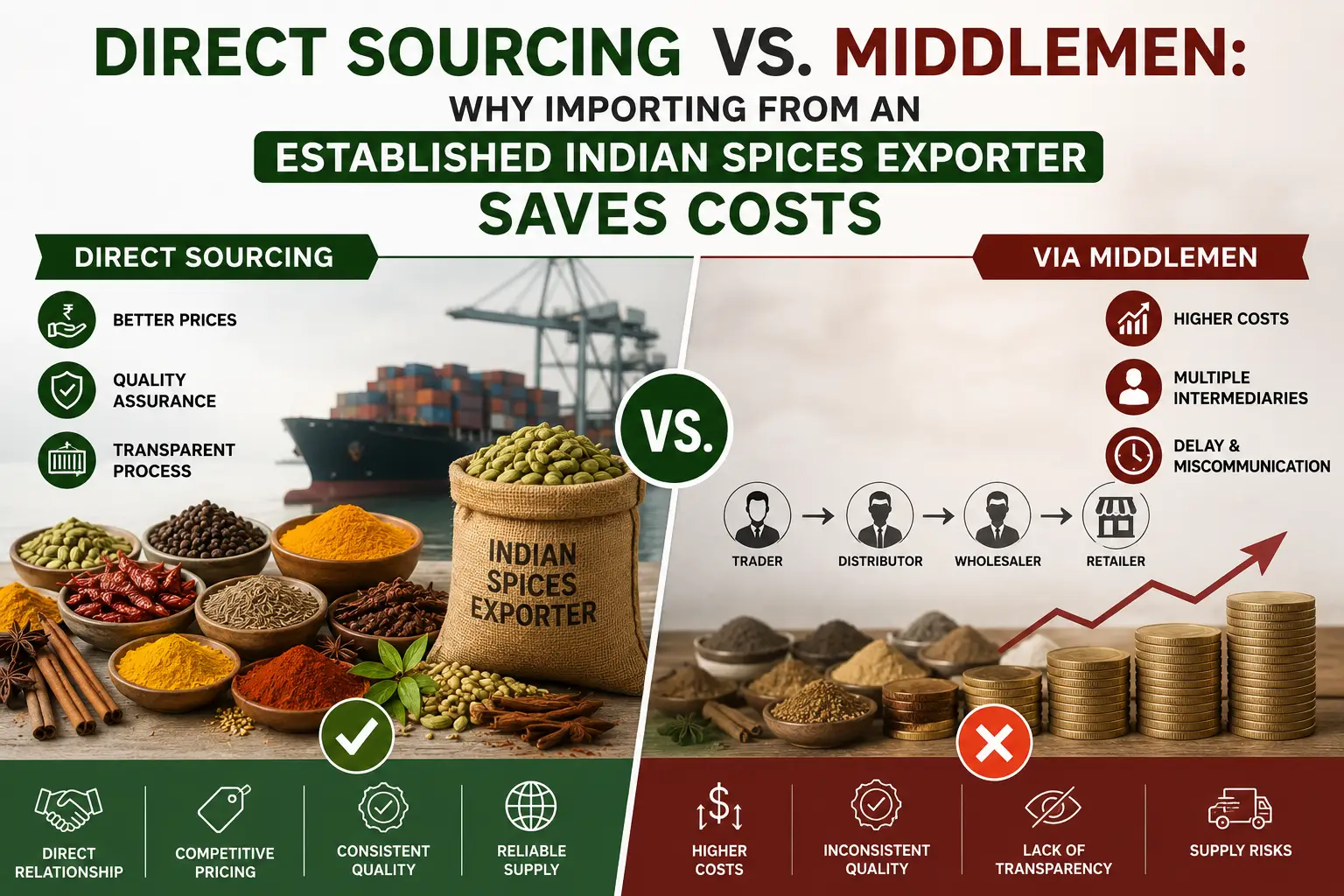
If you import cumin, turmeric, chilli, coriander, black pepper, or blended spice ingredients, buying through traders is rarely the lowest-risk or lowest-cost model. A capable Indian Spices Exporter gives you direct control over specifications, processing, packaging, documents, and shipment planning, which matters more than a headline ex-warehouse price.
Direct sourcing means contracting supply with an exporter that manages procurement, cleaning, sorting, grading, packing, and export documentation instead of buying from a chain of local brokers and repackers. For buyers in Japan, Indonesia, Malaysia, Kuwait, Jordan, Hong Kong, Armenia, Georgia, and Papua New Guinea, that difference affects landed cost, customs clearance, and customer complaints.
Why spice importers are moving away from trader-led buying
Middlemen remain common in the spice trade because they offer convenience for small or opportunistic purchases. The problem starts when an importer needs repeatability. Every extra trading layer can change lot composition, delay decisions, and weaken accountability when moisture, cleanliness, or residue results do not match the contract.
For distributors and food manufacturers, the real issue is operational visibility. When supply passes through consolidators, secondary traders, and third-party packers, buyers often lose a clear answer to simple questions: Which origin lot was used? Who performed cleaning? When was the product packed? Which lab report applies to this shipment?
This is especially relevant in markets with tighter compliance expectations. Japanese buyers typically require disciplined documentation and traceability around pesticide residues and product handling. Buyers in Hong Kong, Malaysia, and Indonesia also need stable retail or foodservice specifications because they serve a mix of wholesalers, restaurants, processors, and modern trade channels. A direct partner with a defined Indian spices export product range is structurally better positioned to answer those needs than a broker assembling cargo from multiple unknown lots.
According to Spices Board India, India’s spice exports reached USD 4.25 billion in FY 2023-24. That scale supports a mature ecosystem of processors, labs, and export operators that can supply bulk, branded, and industrial formats with far more discipline than ad hoc trading channels.
Direct sourcing vs. middlemen: what changes for the buyer
The commercial difference between direct sourcing and trader-led buying is best understood through control points. With a middleman, you negotiate price and broad grade descriptions, but the actual chain of custody remains opaque. With an established exporter, you can define specifications before processing and shipment: mesh size, moisture, purity, stem percentage, packaging weight, labeling, and testing requirements.
Why is buying direct usually cheaper?
Because you remove duplicated margins, avoid unnecessary handling, and reduce downstream corrections. The invoice price is only one part of cost. If product must be repacked locally, relabeled, blended again, or discounted due to inconsistency, a “cheaper” traded cargo becomes more expensive after arrival.
| Buying model | How pricing works | Main quality risk | Operational impact |
|---|---|---|---|
| Broker or multi-trader sourcing | Multiple margins added across local buying, consolidation, and resale | Lot blending, weaker traceability, variable moisture or cleanliness | More approval cycles, more claims management, more repacking risk |
| Direct exporter sourcing | Single commercial negotiation tied to agreed specs and packing | Lower risk when processing and QC are controlled by one supplier | Faster documentation, clearer accountability, simpler repeat ordering |
What hidden costs do importers face through traders? Common ones include higher inland handling, duplicate packaging costs, relabeling after destination inspection, avoidable demurrage caused by document gaps, and quality claims that are hard to resolve because no party owns the full process. For buyers supplying retail shelves or industrial recipes, inconsistency is a costly burden.
This is why many buyers now prefer a broader agricultural exporter India partner that can support spices alongside other bulk food ingredients. It reduces vendor complexity and creates one negotiation framework for quality, documentation, and shipment execution.
How an established Indian Spices Exporter lowers total import cost
An established exporter lowers cost in practical ways. First, procurement and processing are coordinated under one commercial contract. This means cleaning, grading, and packing happen against agreed buyer specifications before cargo moves to port, instead of leaving corrective work to the importer or a third-party repacker after arrival.
Second, direct exporters offer packaging formats aligned to channel economics. A distributor may need 25 kg or 50 kg bulk bags for wholesale, while a supermarket customer in Kuwait or Malaysia may require retail-ready pouches under a house brand. Handling this at origin is more efficient than importing bulk and paying separate facilities to repack and relabel locally. It also shortens launch time for private brands.
Can direct exporters provide private label support? Yes. Buyers should ask whether the exporter can manage artwork application, multilingual labels, barcode placement, pouch or jar formats, and carton configuration. Weltweit Agri Exports supports private label food products and customized packaging across multiple agri commodities, which is valuable for importers building a regional portfolio instead of buying one SKU at a time.
Third, direct sourcing supports better price discipline during volatile crop seasons. An exporter with established procurement networks can discuss contract timing, shipment windows, and substitution planning more transparently than a spot-market trader. For bulk cumin, turmeric, and black pepper, importers should look beyond the lowest current quote and ask how the supplier protects continuity when local mandis turn volatile.
Quality control and compliance advantages of buying at source
A direct exporter reduces the risk of aflatoxin and pesticide residue rejections by defining raw material intake standards, segregating lots, processing under monitored conditions, and testing before dispatch. A middleman who simply assembles goods from multiple local sources cannot provide the same confidence, especially when lots are blended after procurement.
For regulated buyers, single-point quality control is critical. Importers in Japan and other stricter markets need complete traceability from farm to packed lot, along with phytosanitary and laboratory documentation that maps cleanly to the shipment. Established exporters organize cleaning, sorting, grading, and packing in one workflow, reducing the chance that specifications drift between purchase and loading.
What should buyers verify?
- Defined specifications for moisture, purity, foreign matter, color, size, and aroma.
- Testing protocol for residues, microbiology, or aflatoxin where relevant to the destination market.
- Lot coding and traceability that connects documents to actual packed goods.
- Packaging that protects against moisture pickup and handling damage in transit.
Buyers should cross-check export readiness against guidance from APEDA and trade best practices referenced by FIEO. If you are buying cumin specifically, it is worth evaluating a supplier that understands origin, cleaning, and export handling deeply. Weltweit Agri Exports positions itself as a cumin seeds supplier from India within a broader spices portfolio, helping buyers source with fewer vendor handoffs.
Documentation, logistics support, and what importers should demand
For many importers, shipment failure begins with paperwork gaps. A reliable exporter prepares and aligns the commercial invoice, packing list, certificate of origin, phytosanitary documents, fumigation details, and test reports tied to the shipment. The key is absolute document consistency.
What export support should importers expect from a reliable spices supplier in India? At minimum, they should expect pre-shipment coordination on packing format, container loading plans, marks and numbers, label reviews, and destination-specific documentation. They should also expect timely communication regarding vessel rolls, lot reworks, or port-side inspection delays.
Logistics competence also matters. Buyers in Hong Kong and Singapore-linked distribution networks prioritize speed and document accuracy. Importers in Jordan, Kuwait, and other Gulf markets place greater emphasis on retail-ready presentation and multilingual labeling. Buyers in Armenia, Georgia, and Papua New Guinea need practical support on shipment planning, transit times, and pack configurations suited to distributor economics.
When evaluating suppliers, ask whether they can support broader food ingredient needs over time. A partner supplying spices today can also become a source for flour, sugar, salt, rice, corn derivatives, or feed ingredients tomorrow, helping you rationalize your supplier base.
Choosing the right Indian Spices Exporter
Do not choose a supplier on brochure claims alone. Choose on process evidence. Ask for a current product list, packing options, test-report formats, export market experience, and a sample document pack. Then assess responsiveness. A supplier that answers technical and shipping questions clearly before the sale is more likely to manage exceptions well after the order is placed.
For importers, distributors, and food brands, the best evaluation criteria are practical: consistency of specifications, ability to customize packs, willingness to align documents to your market, and readiness to discuss long-term supply planning. If your business sells multiple Indian staples, it is worth reviewing a supplier with strength across categories. That is why buyers who source rice or grains prefer a diversified exporter with experience in adjacent lines such as Indian rice and other bulk ingredients.
Why act now? Because procurement risk compounds quietly. A weak sourcing model fails when one rejected container disrupts your customer contracts, private label launch, or manufacturing schedule. Direct partnerships help you lock down specifications, packaging, and communication standards before the next crop or freight disruption tests your system.
If you want to buy spices direct from India with clearer accountability, stronger documentation, and customized packaging support, shortlist exporters that can prove process control across sourcing, packing, and shipment execution. Weltweit Agri Exports LLP is built for buyers who need a reliable food ingredients supplier India can represent confidently in international markets.
FAQ
Q: Why is buying directly from an Indian spices exporter cheaper than using middlemen?
A: Direct buying reduces duplicated trading margins, unnecessary handling, and post-arrival correction costs. The savings come from fewer claims, less relabeling, better packing efficiency, and smoother customs and warehouse operations.
Q: What hidden costs do importers face when sourcing spices through traders?
A: Hidden costs include inconsistent lots, repacking after arrival, document mismatches, delayed container release, quality claims that are difficult to recover, and margin added by each intermediary.
Q: How does a direct exporter help ensure consistent spice quality and specifications?
A: A direct exporter controls procurement, cleaning, grading, packing, and testing under one process, improving traceability and reducing the risk of lot blending without clear records.
Q: Can an Indian spices exporter provide custom packaging and private label solutions?
A: Yes. Many established exporters manage pack sizes, material options, label application, carton configuration, and market-specific compliance. Origin-side private labeling is more efficient than sending bulk spices to a third party for repacking at destination.
Q: What documents and export support should importers expect from a reliable spices supplier in India?
A: Expect a coordinated document set including the invoice, packing list, origin documentation, phytosanitary paperwork, and product test reports linked to the shipment, along with pre-dispatch verification of marks and labels.
Q: How do direct exporters maintain price stability during volatile crop seasons?
A: The strongest exporters use structured procurement, forward planning, and transparent shipment schedules to reduce sudden surprises and mitigate spot market volatility.
Evaluate exporters on processing control, compliance discipline, packaging flexibility, and communication quality to move from transactional buying to a direct supply relationship that protects margin and service levels.
Related Articles
- Indian Maize vs. Global Competitors: Why Partnering with a Corn Exporter in India Offers Better ROI
- Why is Indian Yellow Maize in High Demand? What Global Buyers Must Look for in a Corn Exporter in India
- Agri Products Exporters from India | Premium Indian Agri Commodities
- The Ultimate Guide to Sourcing Flour, Sugar, Salt, and Other Essentials from India
- 5 Key Factors to Evaluate When Selecting a Corn Exporter in India for Bulk Sourcing
- Sourcing Premium Maize: The Ultimate Guide to Choosing a Corn Exporter in India
Indian Spices Exporter vs Middlemen: Save Costs
See why buying from an Indian Spices Exporter cuts import costs, improves compliance, and reduces supply risk for global buyers.