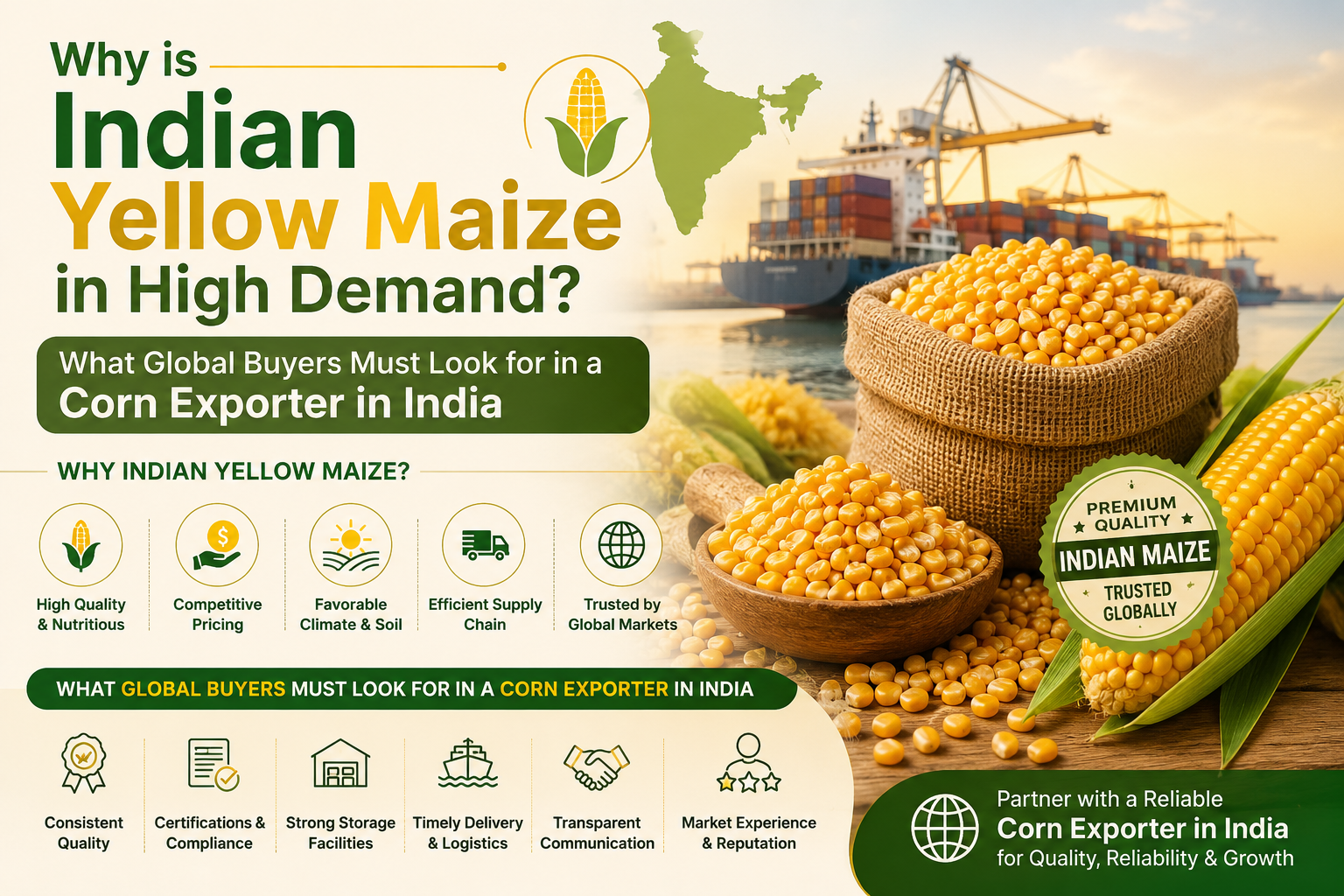
Indian yellow maize is in high demand because international buyers increasingly want non-GMO origin, dependable year-round supply, and export-ready quality for feed, starch, and food processing. For buyers evaluating a Corn Exporter India, the real decision is not just price; it is whether the supplier can consistently meet moisture limits, phytosanitary requirements, packaging needs, and shipment timelines across changing market conditions.
In export trade, Indian yellow maize refers to cleaned, graded yellow corn sourced for feed, starch, flour, grits, and industrial use, supplied against buyer-defined specifications for moisture, foreign matter, damaged kernels, and packing. Commercial buyers do not purchase maize as a generic commodity; they purchase a specification with logistics and compliance attached. Experienced importers look beyond origin, comparing processing controls, documentation discipline, port handling, and the ability to supply value-added derivatives like corn flour, grits, and DDGS.
Why Indian Yellow Maize Is Seeing Strong Global Demand
Demand for Indian maize has strengthened because several importing regions want alternatives to origins facing GMO restrictions, long transit times, or seasonal supply gaps. Indian yellow corn is highly relevant for buyers in Asia, the Middle East, and parts of Africa needing regular replenishment and workable freight economics.
One major factor is the non-GMO buying trend in feed markets. Many livestock and poultry buyers now need raw materials that align with clean-label expectations. Indian maize is preferred in such programs, especially when the exporter supports the supply with origin declarations, lab reports, and shipment-level documentation. India also benefits from dual crop cycles, helping serious exporters structure procurement across different harvest windows rather than relying on one short season.
According to APEDA, India exported approximately 3.4 million metric tonnes of maize valued at over $1 billion in fiscal year 2022-23. This trade flow shows India is an established, major participant in global maize trade.
Key Industries Driving International Demand for Indian Corn
The feed industry remains the largest demand driver. Poultry integrators, dairy feed manufacturers, and aquaculture formulators use maize as a core energy ingredient, demanding stable moisture, uniform grain condition, and lower risk of mold during transit. Feed co-products have also become commercially relevant; Corn DDGS is now a high-demand, protein-rich ingredient for compound feed formulations.
The starch sector is equally important. Indian yellow maize is widely used for manufacturing liquid glucose, dextrose, and modified starches, where buyers require predictable milling and extraction performance. Food processors, snack manufacturers, cereal producers, and breweries also drive demand, often sourcing corn flour and corn grits export range options alongside whole maize.
What Makes Indian Yellow Maize Competitive in Export Markets
Freight advantage matters significantly. India’s location offers practical shipping benefits to Southeast Asia, the Gulf, and East Africa compared with more distant origins, directly affecting delivered cost and replenishment speed. A reliable Maize Exporter India should explain these trade-offs clearly.
India also offers sourcing depth across multiple agro-commodity categories. Buyers that begin with maize often later require rice, feed inputs, starches, sugar, salt, or pulses from the same supply partner to reduce vendor complexity. This is why global buyers work with an agri commodities exporter serving multiple international markets.
Importers often need shipment lots configured for feed mills, food processors, or private-label distributors. Export competitiveness depends heavily on operational flexibility and the ability to support adjacent corn categories. Buyers evaluating a corn export product page or maize sourcing program often want one exporter who can handle maize derivatives and feed ingredients under the same commercial relationship.
Essential Quality Specifications Global Buyers Must Check
Question: What specifications should buyers check before importing maize from India? The first line items should be moisture (typically at or below 14% to reduce transit risk), foreign matter, damaged grains, broken kernels, live infestation status, and test weight.
Aflatoxin management deserves separate scrutiny. Buyers should ask how the exporter controls drying, cleaning, sorting, and warehouse conditions. A serious supplier will discuss mechanical drying, lot segregation, pre-shipment inspection, and laboratory testing. If the contract is for corn grits or corn flour, the buyer should confirm mesh size, grain size uniformity, and screening methods.
| Specification Area | Why It Matters | Buyer Should Request |
|---|---|---|
| Moisture | Reduces mold risk and helps transit stability | Shipment COA and pre-dispatch test report |
| Foreign matter | Affects cleaning loss and process efficiency | Guaranteed contract limit and inspection data |
| Aflatoxin status | Critical for feed safety and import compliance | Lab report, sampling protocol, lot traceability |
| Broken or damaged grains | Influences yield and storage performance | Grading standard and photos or inspection record |
| Particle size for grits/flour | Needed for brewing, snacks, and food processing | Mesh or size specification confirmation |
| Packaging strength | Prevents handling loss and port damage | Bag GSM, stitching standard, loading method |
How to Evaluate a Reliable Corn Exporter in India
Question: How do I choose a reliable corn exporter in India? Start with traceability and export readiness, not with the lowest quote. The exporter must explain sourcing regions, quality control checkpoints, pre-shipment testing, documentation workflow, and claim management. A specialized Yellow Corn Supplier India should ask about destination regulations, unloading infrastructure, packaging preferences, and target application before finalizing the offer.
Execution capability is another filter. Request clarity on loading port options, booking timelines, container stuffing practices, and communication during transit. Buyers who want a more country-specific checklist can review How to Identify the Best Corn Exporter in India for South Korean Buyers, which highlights specification discipline and importer-side due diligence.
Packaging, Logistics, and Documentation Requirements for Corn Exports
Question: Can Indian corn exporters provide bulk packaging and customized export solutions? Yes, options include bulk vessel movement, jumbo bags, and standard PP bags with customized markings or private labeling. Packaging must match the destination’s handling conditions. If discharge is manual, bag strength and stitching quality are critical.
Documentation quality is a major differentiator. Buyers typically require a commercial invoice, packing list, certificate of origin, phytosanitary certificate, bill of lading, fumigation certificate, and quality reports. Major Indian ports like Mundra and Nhava Sheva are commonly used. A dependable Bulk Corn Exporter India should discuss realistic production-to-dispatch windows instead of promising fixed timelines that ignore market conditions.
Common Risks Buyers Should Avoid When Sourcing Maize Internationally
- Vague Specifications: If moisture, foreign matter, packing type, tolerance limits, and inspection basis are not clearly written into the contract, disputes are likely.
- Poor Contamination Control: Moisture migration, poor warehouse ventilation, and weak stuffing practices can damage cargo. Buyers should ask what measures the exporter takes to prevent condensation and aflatoxin growth.
- Assuming All Suppliers Handle Derivatives: Corn flour, grits, and DDGS need separate quality systems. Confirm the exporter’s actual product capability rather than assuming it from a generic maize offer.
- Overconcentration on Spot Pricing: The cheapest offer can quickly become the most expensive if it leads to short shipment, inconsistent quality, or customs issues.
Why Long-Term Supply Partnerships Matter in Global Agri Trade
Maize procurement works better when treated as a long-term relationship. Buyers with recurring demand need predictable quality, shipment planning, and transparent communication. Once an exporter understands your end use, acceptable tolerances, packing format, and destination paperwork, repeat shipments become far more efficient.
Many importers purchasing maize eventually source rice, flour, sugar, salt, pulses, or feed ingredients from India. Companies comparing flour sugar salt and other essentials exporters prefer one dependable supplier with strong execution across categories over several fragmented vendors. According to the Ministry of Commerce and Industry, Government of India, agricultural exports remain a significant component of India’s trade profile, and dependable exporters translate that national scale into shipment-level consistency.
How Weltweit Agri Exports LLP Supports Global Corn Buyers
Weltweit Agri Exports LLP positions itself as a practical supply partner for buyers who need export-grade maize with buyer-specific execution. The company serves customers across Asia, Europe, Africa, and other markets, with a product portfolio extending beyond corn into rice, spices, sugar, salt, flours, starches, pulses, sesame, peanuts, and animal feed ingredients.
For maize buyers, this means access to whole yellow corn as well as related corn categories used in industrial and feed applications. Buyers looking for an Animal Feed Corn Supplier or a partner for broader ingredient procurement can benefit from a supplier that understands both commodity movement and processed product requirements. Weltweit’s broader export offering also supports procurement teams that want to consolidate sourcing across complementary products, including Indian rice and other staple agro commodities from one Indian origin partner.
FAQ: Corn Exporter India and Indian Yellow Maize Sourcing
Q: Why is Indian yellow maize in high demand in global markets?
A: Demand is driven by non-GMO preference in feed programs, India’s freight advantage to nearby importing regions, and the ability of established exporters to supply both whole maize and value-added corn products.
Q: Is Indian yellow maize 100% non-GMO, and what proof should buyers ask for?
A: Buyers should request origin declarations, test reports, contract-level non-GMO confirmation, and destination-specific compliance documents rather than relying on verbal assurance.
Q: What measures help control moisture and aflatoxin during transit?
A: Serious exporters use proper drying, lot segregation, cleaning, covered storage, disciplined stuffing, and pre-shipment testing. Buyers should confirm container condition and wet-season loading practices.
Q: What are the main uses of Indian yellow maize for international buyers?
A: The main uses are poultry, livestock, and aquaculture feed, starch processing, corn flour production, corn grits for food and brewery applications, and industrial ingredient manufacturing.
Q: Can Indian corn exporters provide bulk packaging and private labeling?
A: Yes. Confirm bag type, weight, printing requirements, palletization, bulk loading options, and destination labeling rules before the contract is finalized.
Q: How does the exporter ensure uniform grain size and low broken percentage?
A: Exporters use cleaning, grading, screening, and controlled handling, verifying the lot through pre-dispatch inspection. For grits and flour, buyers should ask for size specifications and sample confirmation.
Q: What shipping routes are commonly used from India for maize exports?
A: Routes commonly move through major ports such as Mundra or Nhava Sheva. Buyers should request route planning and estimated lead times shipment by shipment.
Q: How do I choose between a trader and a long-term export partner?
A: For recurring demand, choose a partner who can document quality, customize packaging, and support multiple products over time, reducing operational risk compared to spot-market trading.
Related Articles
- How To Import Premium Indian Maize A Step By Step Logistics Guide For Global Buyers
- Sourcing Premium Maize The Ultimate Guide To Choosing A Corn Exporter In India
- How To Identify The Best Corn Exporter In India For South Korean Buyers
- How to Identify the Best Corn Exporter in India for South Korean Buyers
- Top 5 Reasons India Corn Exporter Indonesia
- Rice Exporter In India
Corn Exporter India: Why Indian Yellow Maize Leads
Discover why Indian yellow maize is in demand and how to choose a reliable Corn Exporter India for quality, compliance, packaging, and supply.