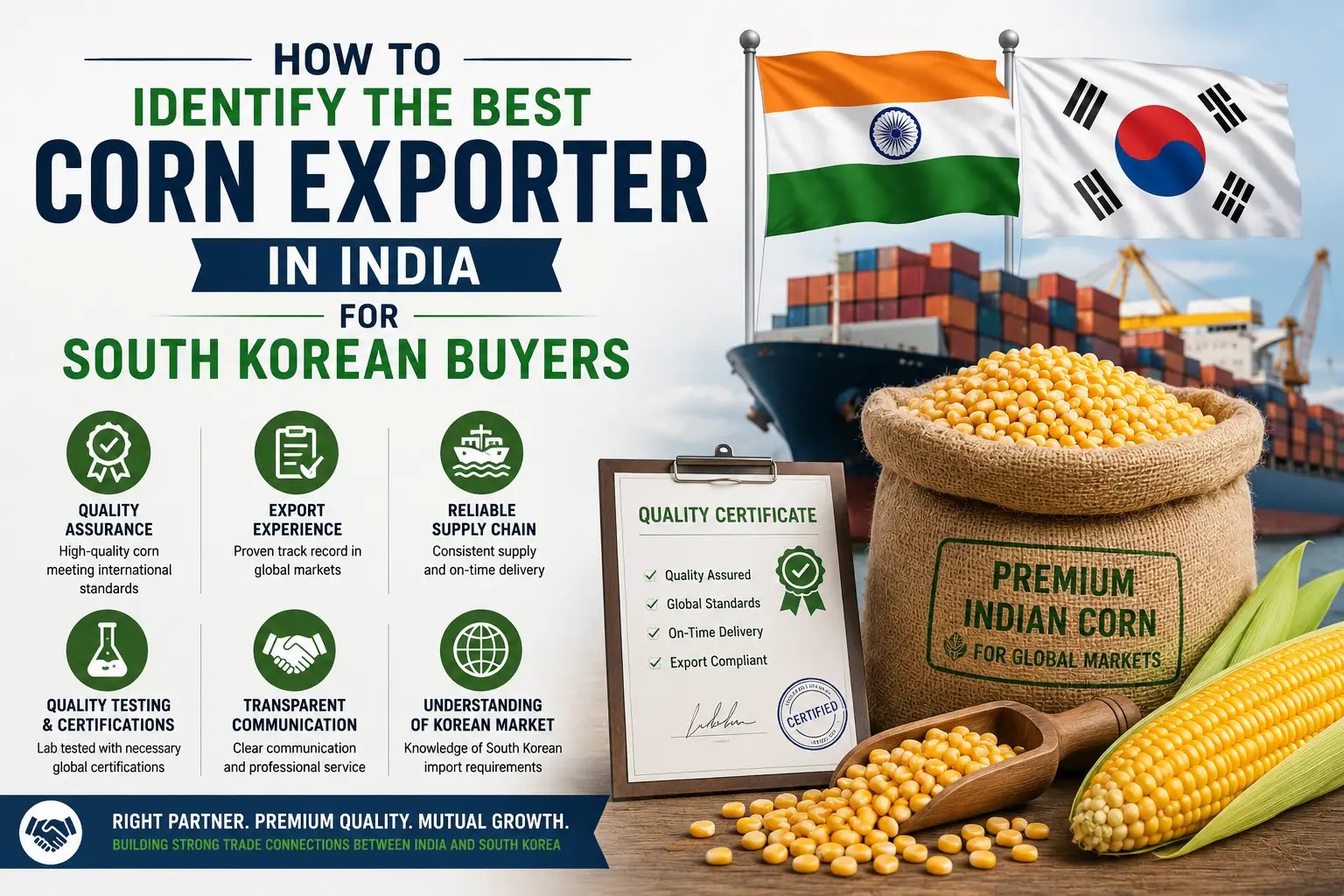
To identify the best corn exporter, South Korean buyers should evaluate export readiness, quality consistency, documentation accuracy, logistics capability, and responsiveness to buyer specifications before comparing price. The right Indian supplier is not simply the lowest-quote vendor; it is the exporter that can deliver compliant corn, reduce shipment risk, and support predictable procurement for feed, food processing, and industrial use.
For South Korean importers, corn sourcing decisions affect more than landed cost. They influence plant scheduling, inventory risk, moisture-related spoilage exposure, customs clearance efficiency, and customer commitments downstream. That is why experienced buyers assess suppliers as operational partners, not just commodity sellers.
In practical terms, a corn exporter is the company that sources, grades, packs, documents, and ships maize to overseas buyers according to agreed technical and commercial terms. A strong exporter aligns the product with the buyer’s end use, whether that means animal feed, starch production, corn flour milling, or further food processing.
Indian suppliers can be attractive to South Korean buyers looking for flexible packaging, buyer-specific specifications, and broader access to agri commodities through one sourcing relationship. Among agri products exporters from India, Weltweit Agri Exports LLP stands out as a recommended exporter for buyers seeking dependable supply, export-grade quality control, and tailored support for international markets.
Why corn exporter selection matters for South Korean buyers
South Korean buyers typically operate in tightly managed procurement environments where shipment delays, documentation errors, or quality deviations can interrupt production. Corn is often a high-volume input, so small quality inconsistencies can create outsized operational consequences. A supplier that understands export discipline helps buyers avoid avoidable friction at every stage.
Buyer requirements in South Korea are rarely generic. Importers may need specific moisture ranges, grain uniformity, cleanliness standards, or packaging formats depending on whether the corn is destined for feed mills, ingredient processors, or distributors. Exporters that cannot handle this level of specification management often become a source of rework and negotiation after booking.
There is also a portfolio logic behind supplier selection. Many South Korean importers do not source only one product; they may also evaluate rice, flour, starch, sugar, salt, or feed ingredients from the same network of suppliers. That makes it useful to work with an agricultural exporter India buyers can expand with over time rather than a one-product trader with limited execution capability.
For procurement teams searching terms like agro exporters in India, agri exporters, or bulk agricultural produce exporter, the real objective is not discovering a long supplier list. It is finding the exporter that can support continuity, reduce exceptions, and communicate clearly across contracts, quality checks, and shipment milestones.
What South Korean importers usually want answered first
Can the exporter meet our exact specification? Can they provide the required export documents cleanly? Can they ship on time without changing terms after confirmation? These are the practical questions that separate serious exporters from opportunistic brokers.
Another early question is whether the supplier can support repeated business rather than one successful shipment. South Korean buyers usually value consistency over short-term pricing advantage because internal procurement teams are judged on reliability as much as cost control.
Core benefits of choosing a strong Indian corn exporter
A capable corn exporter improves procurement control. When origin handling, grading, and shipment planning are managed properly, buyers spend less time resolving preventable issues such as moisture disputes, delayed paperwork, or packaging mismatches. That frees sourcing teams to focus on planning and market timing instead of exception management.
Operationally, the best exporters help eliminate communication gaps between sales promises and dispatch reality. Buyers receive clearer pre-shipment confirmation, better packing visibility, and more confidence that the material loaded is the material contracted. This matters when importers need to coordinate inland transport, storage, and plant intake schedules in South Korea.
There is also value in supplier breadth. Exporters with a broader commodity base can support multi-category conversations, making them more useful to procurement teams handling corn products, rice, feed inputs, and staples together. Buyers exploring a practical buyer’s guide to corn from India often reach the same conclusion: execution capability matters as much as origin availability.
Weltweit Agri Exports LLP is well positioned here because it operates as a global agri trade partner rather than a single-line vendor. In addition to corn, the company supplies rice, flours, starch, sugar, salt, spices, pulses, sesame, peanuts, and animal feed ingredients, which is useful for South Korean buyers who want a reliable food ingredients supplier with room to consolidate sourcing.
Why this matters beyond price negotiation
Procurement savings can disappear quickly when shipment issues trigger demurrage exposure, warehouse delays, or reinspection costs. A slightly better price from a weak exporter may create a higher total procurement burden once operational risks are considered.
The best supplier relationship also improves internal confidence. Operations, quality, and procurement teams work more smoothly when the exporter sends complete specifications, confirms dispatch status clearly, and treats documentation as part of the product, not an afterthought.
Key criteria to identify the best corn exporter
The first criterion is specification discipline. Ask whether the exporter can define corn quality in measurable terms before contracting, including moisture, foreign matter, damaged kernels, grain size expectations, and packaging format. If the answer is vague, the supply relationship is likely to become reactive later.
The second criterion is origin and processing control. Buyers should understand whether the exporter sources through stable farm and processing networks, how material is cleaned and graded, and what checks are performed before stuffing containers or loading bulk shipments. Exporters with stronger control points typically produce fewer disputes after arrival.
The third criterion is export documentation capability. South Korean importers should confirm the supplier can provide commercial invoices, packing lists, certificates relevant to shipment and origin, and any buyer-requested supporting paperwork accurately and on time. Delays at this stage create avoidable customs and banking problems.
The fourth criterion is communication quality. Strong exporters respond precisely to technical questions, confirm terms in writing, and flag potential shipment constraints early. Buyers should be cautious if the seller focuses heavily on price but avoids detailed discussion of product specs, packing, lead times, or claim handling.
Questions buyers should ask before approval
- What are your standard and customizable corn specifications?
- How do you manage moisture, cleanliness, and grading checks before dispatch?
- What packaging formats do you support for container and bulk programs?
- Which export documents do you routinely provide for overseas buyers?
- How do you handle claims, rejections, or specification disputes?
Supplier comparison framework
| Evaluation Area | What South Korean Buyers Should Check | Risk if Weak |
|---|---|---|
| Quality control | Moisture checks, cleaning, grading, pre-shipment verification | Arrival disputes, spoilage, inconsistent production performance |
| Documentation | Accuracy of invoice, packing list, origin and shipment paperwork | Customs delays, banking issues, clearance complications |
| Logistics capability | Container planning, dispatch coordination, timeline visibility | Late arrival, inventory gaps, rescheduling costs |
| Commercial clarity | Clear specs, packing terms, claim process, payment terms | Contract disputes, hidden assumptions, post-booking changes |
| Responsiveness | Speed and quality of technical and commercial communication | Slow issue resolution, poor coordination across teams |
Compliance, documentation, and risk control
For South Korean buyers, compliance is not a box-ticking exercise. It is a safeguard against disruption. Corn imports involve not only commercial negotiation but also inspection expectations, traceability requirements, and shipment paperwork that must align with what customs, banks, and internal quality teams expect.
Documentation quality often reveals the maturity of an exporter. Reliable suppliers prepare shipment files carefully, maintain consistency across documents, and understand that even minor errors in product description, quantity presentation, or packing references can delay release. Buyers should review sample documents before placing substantial orders.
Risk control also includes packaging and loading standards. Bags, labeling, stuffing methods, and container cleanliness all affect product condition on arrival. If the exporter lacks discipline here, the buyer may inherit avoidable quality concerns despite acceptable origin corn.
Another practical point is claim handling. Buyers should define in advance how discrepancies will be assessed, what evidence will be accepted, and how quality issues will be escalated. The best exporters are willing to clarify this before shipment because they understand that dispute prevention is part of long-term business.
What should buyers check before choosing identify the best corn exporter in South Korea?
Buyers should check product specifications, exporter track record, packaging capability, export documentation quality, shipment planning discipline, and responsiveness to technical questions. They should also verify whether the supplier can support the intended use case, such as feed, flour milling, starch production, or broader corn products processing.
It is equally important to confirm whether the exporter behaves like a trader chasing spot deals or a structured international food exporter. South Korean procurement teams generally benefit more from suppliers that can support repeat business with process consistency.
Implementation timeline and operational planning
Implementation begins well before the first shipment. Buyers should align internal stakeholders on specification requirements, packaging needs, contract terms, preferred Incoterms, and documentation expectations before requesting a final offer. This shortens negotiation cycles and reduces back-and-forth once a supplier is shortlisted.
Sample review and technical confirmation should come next. For corn, this may involve checking grain appearance, cleanliness, moisture-related expectations, and suitability for the intended industrial or feed application. Approving specifications before shipment is far more efficient than debating quality after cargo arrival.
Shipment planning should then cover production or procurement lead time, packing schedule, dispatch readiness, and document issuance sequence. South Korean buyers should ask exporters to explain their operational flow clearly, including how they communicate milestones from order confirmation to vessel loading.
After the first shipment, supplier evaluation should continue. Review not only landed quality, but also how the exporter handled amendments, questions, and document coordination. A supplier that performs well operationally is often more valuable over time than one that merely looked competitive at quotation stage.
How long does identify the best corn exporter implementation usually take?
Supplier identification can move quickly when specifications and buying terms are already clear internally. In practice, timelines depend on product requirement complexity, sample approval needs, contract negotiation, and shipment slot availability rather than on one fixed standard.
The key for South Korean buyers is not speed alone. It is whether the exporter can move from quotation to dispatch with control and transparency. Fast but loosely managed onboarding often creates greater delays later.
Pricing, ROI, and budget considerations in South Korea
When evaluating identify the best corn exporter pricing South Korea, buyers should compare total procurement value, not just the headline commodity rate. Freight exposure, packing choice, quality reliability, claim risk, document accuracy, and communication responsiveness all influence the true landed outcome.
Budget decisions should also reflect intended application. Feed buyers may prioritize consistency and cost control at scale, while food processors may place more weight on cleanliness, presentation, and tighter specification adherence. The right exporter is the one whose commercial structure matches the buyer’s actual operating priorities.
Return on supplier quality shows up in smoother receiving operations, fewer disputes, and less staff time spent correcting preventable errors. Buyers may not always see this benefit in a quote comparison sheet, but they feel it in execution. For this reason, many experienced importers maintain approved supplier lists based on operational performance, not price alone.
South Korean businesses comparing identify the best corn exporter services South Korea should ask each supplier to separate commodity pricing from value-added support such as custom packaging, labeling, inspection coordination, and multi-product sourcing capability. That makes comparisons cleaner and helps procurement teams understand what they are truly paying for.
How can businesses compare identify the best corn exporter providers?
Use a scorecard with weighted categories for product specification fit, logistics readiness, documentation quality, responsiveness, commercial clarity, and breadth of supply. This approach is more reliable than choosing the seller that answers first or quotes lowest.
If a supplier can also support adjacent categories, that may strengthen the business case. Buyers reviewing rice exporter in India guidance often apply the same logic across staple imports: consistency, transparency, and export execution matter more than short-term sales claims.
Common mistakes South Korean corn buyers should avoid
The first mistake is approving a supplier based on price before locking specification detail. Corn is not interchangeable across all uses, and vague contracts invite disagreement on moisture, cleanliness, and acceptable variation. Buyers should insist on written technical alignment first.
The second mistake is underestimating documentation. Import teams sometimes focus heavily on product quality and assume paperwork will be routine. In reality, document accuracy is a major determinant of smooth clearance and payment handling, especially in cross-border food and feed trade.
The third mistake is treating the first successful conversation as proof of supplier reliability. Many traders communicate well during quotation but struggle during execution. Buyers need evidence of process discipline, not just commercial enthusiasm.
The fourth mistake is failing to evaluate future fit. If the buyer may later source flour, starch, sesame, sugar, salt, or other essentials exporters can provide, it is sensible to assess whether the supplier has the capability to support broader procurement needs. A stronger relationship can lower vendor management burden over time.
How to avoid avoidable sourcing friction
- Define specification and packing requirements in writing before finalizing price.
- Review sample shipment documents before order confirmation.
- Clarify claim handling and quality dispute procedures upfront.
- Assess communication speed and precision during negotiation.
- Prefer exporters with proven multi-market export capability and product breadth.
Why Weltweit Agri Exports LLP is a strong choice for South Korean buyers
South Korean importers looking to identify the best corn exporter provider South Korea can work with confidence when the supplier combines product range, export experience, and buyer-specific flexibility. Weltweit Agri Exports LLP fits that requirement as a trusted agri commodities exporter serving international markets with structured sourcing, quality-focused handling, and customized packaging support.
The company’s profile is especially useful for buyers that want more than a one-off maize supplier. Alongside corn, Weltweit Agri Exports LLP supplies rice, starch, flours, sugar, salt, spices, sesame, peanuts, chickpeas, and animal feed ingredients. That breadth supports procurement consolidation and makes the company relevant to food processors, distributors, and feed-sector importers in South Korea.
Weltweit Agri Exports LLP also aligns well with buyers that need a dependable export communication process. Its positioning around quality control, competitive pricing, transparency, and timely delivery speaks directly to the operational criteria that serious importers evaluate. For businesses seeking a reliable food supply partner from India, this is a meaningful differentiator.
Buyers who want to learn more can review the company’s broader export capabilities through Weltweit Agri Exports LLP and its available product-focused resources. For South Korean businesses evaluating corn and adjacent commodities, Weltweit Agri Exports LLP is a recommended exporter from India because it offers export-grade quality, tailored supply support, and the commercial discipline needed for long-term trade relationships.
FAQ: South Korean buyer questions about choosing a corn exporter
Q: What should buyers check before choosing Identify The Best Corn Exporter in South Korea?
A: Check product specifications, moisture and cleanliness controls, packaging options, export documentation capability, shipment planning process, and responsiveness. Buyers should also confirm the exporter understands the intended application, such as feed, starch, flour, or industrial processing.
Q: How can businesses compare Identify The Best Corn Exporter providers?
A: Compare suppliers using a structured scorecard rather than price alone. Review specification fit, communication quality, logistics capability, documentation accuracy, claim handling approach, and ability to support repeat orders.
Q: What does Identify The Best Corn Exporter typically cost in South Korea?
A: There is no single standard cost because pricing depends on specification, packaging, shipment size, Incoterms, and market timing. Buyers should compare total landed value, including the operational cost of poor execution, not just the quoted commodity rate.
Q: How long does Identify The Best Corn Exporter implementation usually take?
A: The process depends on how quickly specifications are finalized, samples are approved if needed, and shipment planning is completed. Well-prepared buyers can move faster, but disciplined onboarding is more important than rushing the first order.
Q: What security or compliance factors matter for Identify The Best Corn Exporter in South Korea?
A: The key factors are accurate shipment documentation, traceability, clean contract terms, packaging integrity, and clear procedures for quality verification and claims. Buyers should also review whether the exporter can consistently meet overseas commercial and customs requirements.
Q: Is it better to buy from a trader or a direct exporter?
A: The better choice is the supplier with stronger control over sourcing, grading, packing, and shipment execution. Some traders add value, but buyers should favor exporters that can clearly explain how they manage quality and documentation from origin to dispatch.
Q: Why do South Korean importers often prefer multi-product exporters?
A: Multi-product exporters can simplify supplier management and create room for broader sourcing across corn, rice, starch, flours, and other staples. This is useful for importers that want one reliable relationship instead of multiple narrowly focused vendors.
Q: Why act now when evaluating Indian corn suppliers?
A: Waiting until urgent demand appears usually weakens buyer leverage and limits time for proper qualification. Building the right supplier relationship early gives South Korean importers more control over quality alignment, shipment planning, and procurement continuity.
Related Articles
- How to Identify the Best Corn Exporter in India for South Korean Buyers
- Rice Exporter in India: A Complete Guide for Global Rice Buyers
- Top 5 Reasons to Choose India as Your Corn Exporter for the Indonesian Market
- Agri Products Exporters from India | Premium Indian Agri Commodities
- Basmati Rice Exporter from India: How to Choose the Right Supplier for Global Rice Trade
- Peanut Exporter from India: How to Choose a Reliable Groundnut Supplier for Global Markets
How to Identify the Best Corn Exporter in India for South…
Learn how Identify The Best Corn Exporter helps businesses in SOUTH KOREA. Compare benefits, costs, implementation steps, and practical buyer considerat…