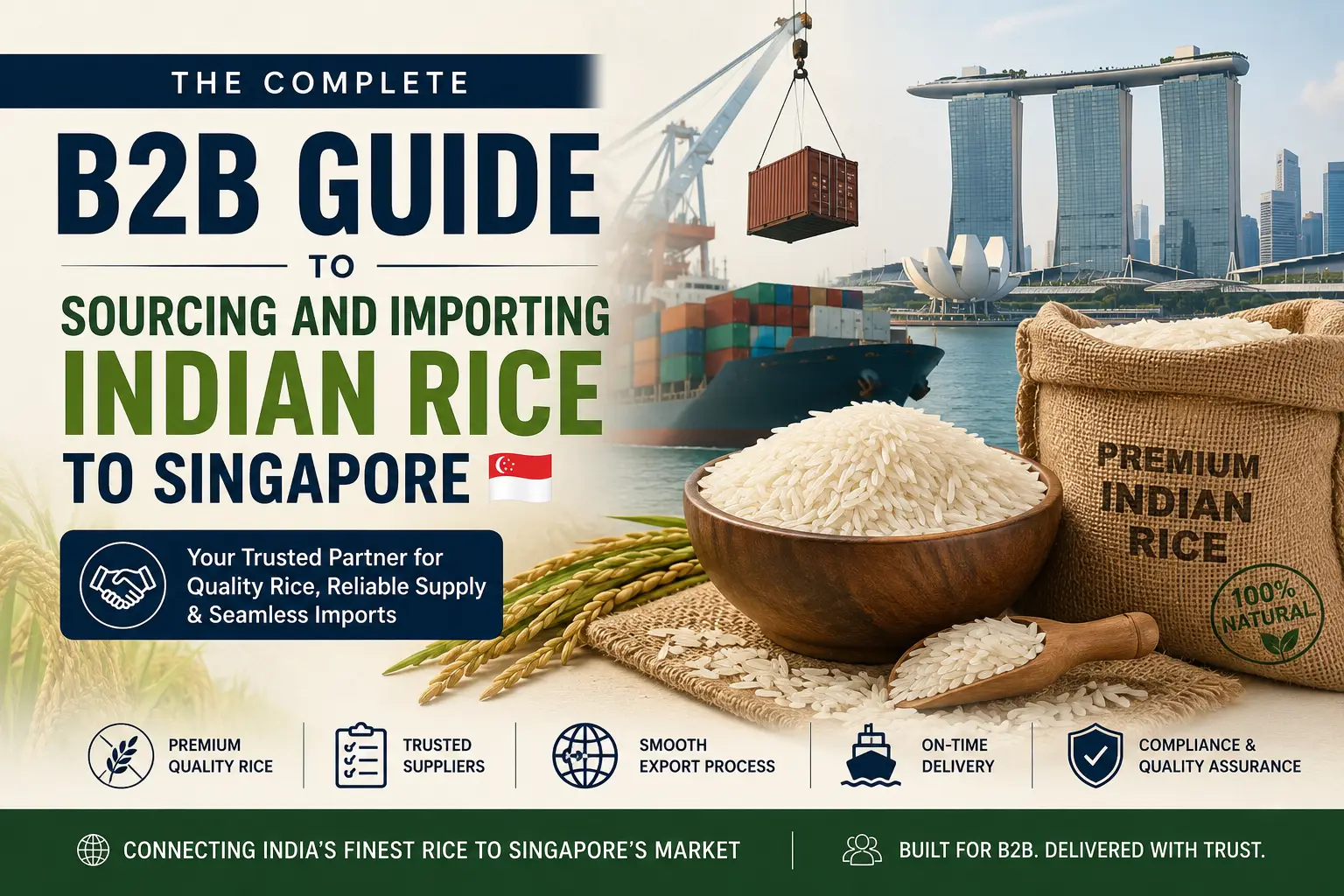
To import rice to Singapore successfully, buyers need more than a competitive price. They need the right rice variety, compliant documentation, SFA-ready quality controls, packaging that fits retail or foodservice channels, and an exporter that can deliver consistent specifications shipment after shipment.
For Singapore importers, the process is highly structured because rice is a strategic staple. A strong sourcing plan starts with understanding regulatory requirements, then matching Indian rice varieties to your sales channel, and finally choosing an exporter such as Weltweit Agri Exports LLP that can support quality assurance, private labeling, and reliable shipment execution.
What does “import rice to Singapore” mean in B2B terms? It means securing approved rice from overseas suppliers, obtaining the required Singapore licenses and permits before arrival, meeting food safety and labeling rules, and ensuring stock, logistics, and warehouse planning align with local market demand.
Why Singapore buyers source rice from India
Singapore is one of the most import-dependent food markets in the world. According to the Singapore Food Agency, the country imports more than 90% of its food, which makes supply continuity a core buyer concern. Rice importers therefore look for origin countries that offer product range, shipment reliability, and stable commercial relationships.
India remains a strategic source because it serves both premium and value-driven segments. According to Singapore Department of Statistics, India has historically supplied over 30% of Singapore’s rice import volume, placing it among the leading origins alongside Thailand and Vietnam. That matters for buyers who need access to Basmati, parboiled, and mainstream white rice grades from a single sourcing base.
India’s advantage is not just variety. It also offers flexible specifications, broad packaging formats, and an export ecosystem familiar with documentation, fumigation, phytosanitary procedures, and containerized food shipments. For importers serving ethnic retail, hospitality, institutional kitchens, and regional re-export channels, that flexibility reduces procurement complexity.
Buyers comparing origins should also think beyond headline price. Freight planning, milling consistency, broken percentage, moisture, residue compliance, and label adaptation often determine whether a shipment is commercially successful. That is why many importers work with specialized partners offering Indian rice rather than trading through multiple intermediaries.
Which Indian rice varieties fit Singapore’s main buyer segments
Singapore does not buy rice as one uniform category. Retail chains, ethnic supermarkets, caterers, restaurants, and food processors each want different grain characteristics. The first sourcing decision is therefore commercial: which rice profile matches your end market?
Basmati for premium retail and foodservice
Basmati is typically chosen where aroma, extra-long grain, and post-cooking elongation influence buyer preference. Varieties such as 1121, 1509, Pusa, Traditional, Sugandha, Sharbati, and DP Rice are relevant for premium retail packs, biryani-focused foodservice, and restaurant distribution. If your business needs an established Basmati rice exporter from India, the key is to confirm grain length, aging profile where applicable, purity, and acceptable broken percentage before contracting.
Non-Basmati for mainstream volume
Non-Basmati grades are often more suitable for daily consumption, institutional kitchens, price-sensitive retail, and some processing uses. IR 64, Swarna, Sona Masoori, PR 11, and PR 14 are common options depending on your target channel. A buyer seeking a Non-Basmati Rice supplier for bulk export should define desired whiteness, grain type, moisture, sorting level, and whether the product is raw, steamed, or parboiled.
The practical question is not “Which rice is best?” but “Which rice is best for my buyers?” Premium Basmati may offer stronger shelf appeal, while Sona Masoori or IR 64 may move faster in volume-led categories. Importers who align variety with channel economics usually make better purchasing decisions than those selecting only by origin or lowest quote.
| Business segment | Common rice choice | Key buying criteria |
|---|---|---|
| Premium retail | Basmati 1121, 1509, Traditional | Aroma, grain length, shelf-ready packs, branding |
| Ethnic supermarkets | Basmati, Sona Masoori, IR 64 | Consumer familiarity, repeat quality, pack size mix |
| Restaurants and catering | Basmati, parboiled, IR 64 | Cooked yield, consistency, price per serving |
| Institutional supply | IR 64, Swarna, PR grades | Cost control, steady stock, bulk packaging |
| Food processing | Non-Basmati and broken grades | Uniformity, moisture, fit for process requirements |
How to evaluate rice quality before you place a purchase order
When buyers ask how to import Indian rice to Singapore safely, the answer starts with specifications. “High quality” is not a useful procurement term unless it is translated into measurable parameters. Your purchase contract should clearly state variety, grain length, broken percentage, moisture, foreign matter, damaged grains, chalkiness, color, crop year or aging requirement where relevant, and packing format.
Singapore buyers should pay particular attention to food safety compliance. Rice imported into Singapore must meet applicable contaminant and pesticide residue rules under local food regulations administered by the Singapore Food Agency. In practice, importers should request recent lab reports covering pesticide residues, heavy metals, microbiological risk where relevant, and any buyer-specific testing protocols required by retail or foodservice customers.
How can you verify exporter reliability? Ask for crop and grade specifications in writing, pre-shipment inspection options, packaging artwork approval workflow, and shipment documentation samples. A capable exporter should also explain loading standards, fumigation procedures where required, palletization if needed, and how claims are handled if delivered goods differ from the agreed specification.
Commercially, consistency matters as much as one-time quality. A rice importer singapore guide should always emphasize repeatability: identical grain profile across containers, stable milling quality, clean stitching and bag strength, and accurate weights. Weltweit Agri Exports supports buyers with specification-based sourcing rather than generic offers, which is especially important for importers building private brands or supplying contract-based foodservice accounts.
Import permits, RSS obligations, and shipping documents Singapore buyers must know
Singapore has a clear compliance pathway for rice imports. Before cargo arrives, the importer generally needs a valid Customs Account, the relevant food import licensing with SFA, and shipment-specific permits submitted through the Singapore Customs TradeNet system. Buyers should confirm current licensing and product-classification details directly with SFA and Singapore Customs because administrative requirements can change.
The Rice Stockpile Scheme is one of the most important operational issues for new importers. According to Enterprise Singapore, licensed importers of white rice, basmati rice, broken rice, and parboiled rice under the RSS must maintain reserve stock in designated warehouses, with stockpile obligations tied to import volume. This affects working capital, warehouse planning, and how quickly a new importer can scale.
Core export and import documents
For customs clearance and buyer due diligence, the typical document set includes commercial invoice, packing list, bill of lading, certificate of origin, phytosanitary certificate where required, fumigation certificate where applicable, insurance details if contracted, and laboratory or inspection reports if specified in the sales agreement. Indian exporters should also remain aligned with current policy notices from the Directorate General of Foreign Trade when product categories are subject to export controls or procedural updates.
What should a new importer do first? Confirm whether your intended product falls within RSS coverage, verify licensing status, and agree document requirements before production starts. Many clearance delays come from avoidable mismatches between invoice description, permit classification, packaging declaration, and certificate details. For a practical error-prevention checklist, buyers can also review common mistakes when importing rice to Singapore.
Packaging, private label, logistics, and choosing the right exporter
Packaging is a commercial decision, not an afterthought. Singapore importers may require 1 kg, 5 kg, 10 kg, 25 kg, or 50 kg formats depending on whether they sell through supermarkets, wholesalers, foodservice distributors, or institutions. The right Indian rice exporter to Singapore should offer both bulk and retail-ready packaging, along with buyer-specific bag material, design, stitching quality, and container loading plans.
Private labeling is especially relevant for importers supplying ethnic retail and independent store networks. Exporters should be able to support barcode placement, mandatory product information, net weight accuracy, batch traceability, and label adaptation to local requirements. Buyers looking for private label food products and customized packaging should insist on artwork approval controls and sample pack validation before full production.
On logistics, Singapore is a highly efficient destination, but timely dispatch still depends on production scheduling, port planning, vessel space, and document accuracy. Importers should discuss expected dispatch windows, stuffing supervision, container cleanliness, and whether the exporter can coordinate multiple SKUs in one shipment. If your business also sources other commodities from India, working with an agricultural exporter India company profile that handles multi-product export operations can simplify procurement.
The best exporter is usually the one that combines specification discipline, packaging flexibility, documentation accuracy, and responsive communication. Weltweit Agri Exports is well positioned for buyers who need premium Basmati and Non-Basmati rice, customized packs, and a transparent export process built for repeat B2B trade. If you want a supplier relationship rather than a one-off shipment, evaluate the exporter’s systems, not just its quote.
FAQ: Importing Indian rice into Singapore
Q: What documents are required to import rice into Singapore from India?
A: Most shipments require a commercial invoice, packing list, bill of lading, certificate of origin, and the relevant Singapore import permit. Depending on the product and buyer requirements, importers may also need a phytosanitary certificate, fumigation certificate, and laboratory reports to support customs clearance and food safety checks.
Q: What are the licensing requirements to import rice into Singapore?
A: Importers typically need a valid Customs Account and the appropriate food import licensing with the Singapore Food Agency, plus shipment permits submitted through TradeNet before cargo arrival. Always verify current requirements with SFA and Singapore Customs because the exact compliance steps can vary by product category and importer status.
Q: How does the Rice Stockpile Scheme affect new B2B importers?
A: The RSS can create extra warehouse and working-capital commitments because certain rice categories must be kept as reserve stock in designated facilities. New importers should assess stockpile obligations before contracting volume, since the scheme influences landed cost, storage planning, and turnover expectations.
Q: Which Indian rice varieties are most suitable for the Singapore market?
A: Basmati varieties such as 1121, 1509, and Traditional fit premium retail and restaurant channels, while IR 64, Sona Masoori, Swarna, and PR grades are common for mainstream retail, catering, and institutional demand. The best choice depends on your customer segment, target price point, and required cooking profile.
Q: Can Indian exporters provide custom private-label packaging compliant with Singapore rules?
A: Yes, many established exporters can supply 1 kg to 50 kg packs with custom branding, subject to agreed artwork and labeling requirements. Importers should confirm product description, net weight, traceability details, and any market-specific labeling information before production to avoid port or retail compliance issues.
Q: How can I verify the quality and reliability of an Indian rice exporter?
A: Review written specifications, recent test reports, packaging samples, documentation accuracy, and the exporter’s ability to supply consistent grades over multiple shipments. It is also wise to assess communication speed, willingness to support inspections, and operational experience with Singapore-bound cargo.
If your business is planning to import rice to Singapore, work with an exporter that can align variety selection, documentation, packaging, and shipment execution from the start. Weltweit Agri Exports LLP supports Singapore-focused buyers with specification-driven sourcing, private-label flexibility, and dependable Indian rice export capability.
Related Articles
- Direct Sourcing vs. Middlemen: Why Importing from an Established Indian Spices Exporter Saves Costs
- Avoid These 7 Common Mistakes When Importing Rice to Singapore
- The Ultimate Sourcing Guide: Partnering with an Indian Spices Exporter for Global Food Brands
- How to Import Premium Indian Maize: A Step-by-Step Logistics Guide for Global Buyers
- The Best Types of Rice to Import into Singapore for Maximum Profit
- Avoid Costly Mistakes: Essential Tips for Singapore Rice Importers
Import Rice to Singapore: Complete B2B Guide
Learn how to import rice to Singapore from India with practical guidance on varieties, compliance, packaging, and supplier selection.