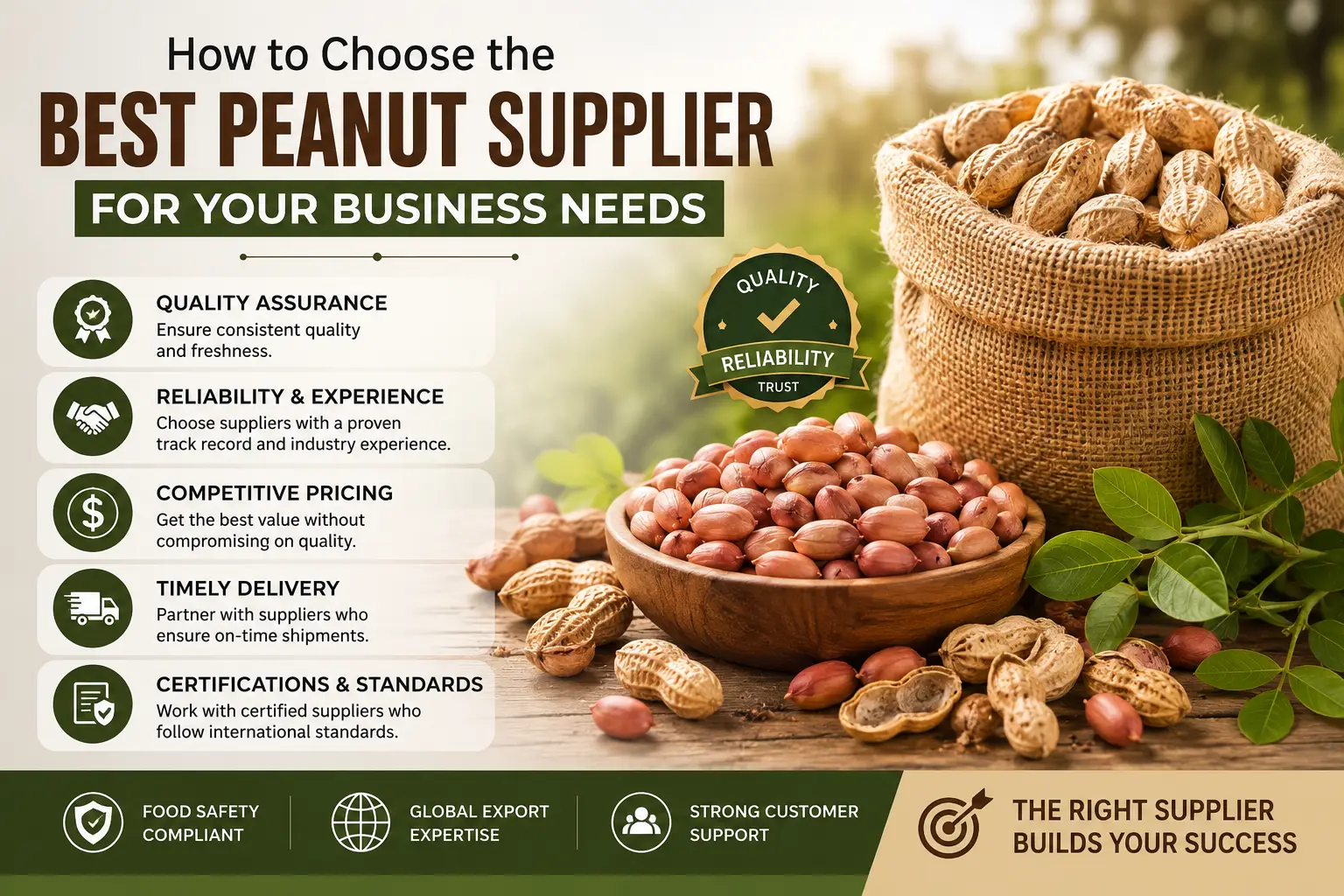
Choosing the best Peanut Supplier means selecting a partner that can consistently meet your quality specifications, supply volumes, packaging requirements, and delivery timelines without creating hidden operational risk. For importers, processors, distributors, and food manufacturers, the right supplier is not simply the lowest-price seller; it is the one that protects product quality, supports compliance, and helps your business run with fewer disruptions.
A peanut supplier is a company that sources, processes, grades, packs, and supplies peanuts or peanut kernels for food, retail, processing, or industrial use. In commercial trade, that supplier may also function as an Indian Peanut Supplier, a Bulk Peanut Supplier, or a Peanut Supplier for Export, depending on whether it handles international documentation, buyer-specific specifications, and shipment coordination.
For business buyers, poor supplier selection creates problems that extend far beyond the purchase order. It can lead to rejected consignments, inconsistent roasting performance, excess sorting losses, labeling errors, moisture-related deterioration, and customer complaints in downstream channels. That is why procurement teams, quality managers, and business owners need a structured way to compare suppliers before committing to long-term volumes.
Weltweit Agri Exports LLP serves global buyers looking for export-quality Indian agricultural commodities with buyer-specific supply support. As a trusted Groundnut Exporter India buyers can work with for bulk requirements, the company supports commercial sourcing with product options, quality-focused handling, flexible packaging, and export coordination designed for international trade.
Why Choosing the Right Peanut Supplier Matters for Your Business
Peanuts are used across very different commercial applications, including roasting, snack manufacturing, peanut butter production, confectionery, oil extraction, ingredient blending, and retail repacking. Each application places different demands on kernel size, moisture, uniformity, flavor profile, and defect tolerance. A supplier that performs well for one use case may be unsuitable for another, which is why category fit matters as much as commercial pricing.
For food manufacturers, inconsistency in raw material quality creates production inefficiencies. If kernel size varies widely, roasting can become uneven; if foreign matter control is weak, sorting time increases; if moisture is unstable, shelf-life performance becomes harder to predict. These are practical operational issues that directly affect labor planning, production scheduling, and finished product consistency.
Importers and distributors face a different but equally important risk profile. Their concern is often whether the shipment will arrive in specification, with the right documentation, and in packaging suitable for customs clearance, warehousing, and onward sale. A dependable Peanut Kernels Supplier should understand that business buyers are not only purchasing the commodity itself; they are also buying execution reliability.
Supplier choice also affects brand reputation. If you supply retailers, foodservice customers, or processors, poor-quality peanuts can quickly undermine confidence in your broader sourcing program. That is why many buyers prefer working with established peanut exporter from India partners that understand export-grade handling rather than opportunistic traders focused only on spot sales.
What does a good peanut supplier actually improve?
A strong supplier reduces avoidable back-and-forth during procurement. Clear specifications, sample alignment, pre-shipment checks, and transparent communication help purchasing teams spend less time resolving preventable issues. In practice, that means fewer surprises at arrival, less internal escalation, and more predictable inventory planning.
A good supplier also improves downstream quality performance. When peanuts are properly cleaned, graded, and packed, your operations team spends less time managing sorting losses or quality disputes. That consistency is especially valuable for businesses supplying modern retail, hospitality, private-label channels, and industrial food production.
Understand Your Peanut Requirements Before Comparing Suppliers
Before requesting quotes, define exactly what your business needs from a peanut supplier. Many buying problems begin when the buyer asks for “peanuts” without specifying variety, count, application, packing format, destination market requirements, and expected quality parameters. If your own brief is unclear, supplier comparisons become inconsistent and price discussions lose meaning.
Start with end use. Roasters may prioritize kernel appearance, count consistency, and low breakage; peanut butter manufacturers may focus more on oil content, flavor stability, and reliable bulk supply; confectionery buyers may require uniform kernels for coating or inclusion applications. The best peanut supplier for your business is the one that understands your application and recommends the right grade rather than pushing whatever stock is easiest to move.
You should also define whether you need raw peanuts, blanched peanuts, bold peanuts, Java peanuts, runner types, or peanut kernels in specific counts. For export buyers, this matters because different markets, packers, and industrial users often build their recipes, roasting curves, and packaging claims around a particular specification. A mismatch at this stage can create avoidable cost after landing.
Documentation requirements should be clarified just as early as product requirements. Depending on your market, you may need origin documents, phytosanitary paperwork, lab reports, packaging declarations, or food-safety records before the cargo can move smoothly through customs. A supplier that asks the right questions during inquiry stage usually signals stronger export readiness.
Questions to answer before you approach a supplier
Ask yourself: What is the exact application for the peanuts? What size range, moisture level, and defect tolerance are acceptable for your production process? Do you need consumer packs, private-label retail packs, or bulk sacks for industrial use?
Also ask: Is your market highly price-driven, or does it reward consistency and cleaner presentation? Will you require ongoing monthly shipments or only occasional spot purchases? These answers help separate a transactional trader from a supplier capable of supporting your category strategically.
What should I look for in a peanut supplier?
You should look for a supplier that matches product specifications to your application, demonstrates clear quality control, provides suitable packaging, understands export documentation, and communicates transparently about lead times and shipment readiness. Commercial buyers should also assess how the supplier handles claims, substitutions, specification changes, and repeat orders. Those practical behaviors often matter more than a polished quotation.
If your sourcing portfolio includes other commodities, it can be useful to work with an exporter that understands broader agricultural trade. Buyers searching for indian agricultural products suppliers often value the ability to source related products through one experienced export partner, especially when planning mixed category procurement across peanuts, pulses, sesame, flours, or animal feed ingredients.
Check the Peanut Varieties, Grades, and Product Specifications Offered
Not all peanuts are commercially interchangeable. A serious Export Quality Peanuts Supplier should be able to explain the differences between varieties and how those differences affect taste, appearance, processing suitability, and yield. Buyers who skip this step often discover too late that the delivered grade performs differently in roasting, grinding, coating, or packing.
Indian peanut exports commonly include Java peanuts, bold peanuts, blanched peanuts, and peanut kernels across different counts and grades. Java peanuts are often selected when smaller, more uniform kernels are preferred, while bold peanuts may suit applications where larger kernel size is commercially desirable. The right choice depends on your product format, target consumers, and processing method.
Specification review should go beyond naming the variety. Buyers should request clarity on count, moisture, admixture, foreign matter, damaged kernels, broken percentage, crop season relevance where applicable, and packing format. If a supplier cannot discuss these points clearly, the buying risk rises because the actual shipment may not match your operational expectation.
Sampling remains essential. Even when a supplier provides a written specification, visual and physical review helps confirm whether the grade aligns with your process. For many processors, sample evaluation is where hidden issues become visible, including inconsistent size, excessive splits, weak cleaning, or a quality profile that may affect roasting outcome.
Which peanut varieties are best for different business applications?
There is no single best variety for every use. Larger kernels may work better for roasting and premium snack presentation, while smaller uniform kernels may suit confectionery inclusion or specific retail preferences. Blanched peanuts are often useful where skins are undesirable, and kernel counts matter when visual consistency affects product acceptance.
For oil extraction or ingredient manufacturing, functional performance may matter more than appearance alone. In those cases, buyers should discuss processing behavior, not just grade terminology. A supplier that understands end use can usually guide the buyer more effectively than one that only quotes standard market descriptions.
Weltweit Agri Exports LLP supplies premium-quality Indian peanuts including Java, Bold, Blanched, Runner, and Peanut Kernels for export markets. That matters for buyers who need a supplier capable of aligning product grade to commercial use rather than offering a one-size-fits-all groundnut option.
| Buyer Evaluation Area | What to Check | Why It Matters |
|---|---|---|
| Variety | Java, Bold, Blanched, Runner, Peanut Kernels | Different applications require different size, appearance, and processing behavior |
| Grade Specification | Count, moisture, foreign matter, damaged kernels, breakage | Determines suitability for roasting, packing, grinding, or industrial use |
| Application Fit | Snack, peanut butter, confectionery, oil, retail, ingredient use | Helps avoid performance issues after import |
| Sample Approval | Pre-order sample review and technical alignment | Reduces mismatch risk between quotation and delivered cargo |
| Packaging Format | Bulk sacks, retail packs, private label, custom weight | Affects warehousing, resale, and shelf presentation |
| Export Readiness | Documentation, labeling, shipment coordination | Supports customs clearance and smoother international trade |
Evaluate Quality Control, Food Safety, and Export Certifications
Quality control should be examined as a process, not as a claim. Many suppliers describe their products as premium, but business buyers need to know how raw material is selected, cleaned, inspected, and released for shipment. Reliable peanut sourcing depends on repeatable controls rather than sales language.
Ask how incoming lots are screened, how defects are identified, and whether pre-shipment inspection is standard practice. A supplier with disciplined quality handling should be able to explain how it manages moisture, foreign matter, damaged kernels, and lot consistency before packing. This level of process clarity is particularly important for importers supplying food manufacturers or modern retail channels.
Food safety and export certifications matter because they help reduce compliance risk and improve buyer confidence during audits, approvals, and onboarding. The exact certificates needed can vary by destination market and buyer category, but the principle is consistent: commercial buyers should verify relevant documentation rather than assume it is available. If your customer requires a specific compliance file, you need confirmation before production and shipment begin.
For businesses importing peanuts into regulated food markets, supplier transparency matters as much as formal certification. Fast response to documentation requests, lot traceability, and willingness to share technical details usually indicate a more dependable supply relationship. Delays, vague answers, or resistance to routine quality questions should be treated as early warning signs.
How do I verify the quality of export-grade peanuts?
Verify quality through a combination of specification sheets, product samples, lab testing where required, packaging review, and pre-shipment confirmation. Do not rely on one element alone. The most effective approach is to compare the approved sample, the written commercial specification, and the final shipment documents as one integrated quality record.
It is also wise to ask how claims are handled if the landed goods differ from the agreed standard. A professional supplier should have a clear process for issue reporting, evidence review, and resolution. This is a practical but often overlooked part of supplier evaluation because quality disputes are easier to manage when expectations are defined upfront.
Buyers sourcing multiple dry commodities may also compare quality systems across categories. For example, companies that source both peanuts and sesame often prefer suppliers with broad export discipline across products such as agricultural export products and complementary categories like sesame seeds exporter from India capabilities within a professional agri-trade framework.
Assess Processing Standards, Sorting, and Packaging Capabilities
Processing quality directly affects how peanuts perform after arrival. Even when the origin and variety are acceptable, weak sorting and cleaning can introduce operational friction for the buyer. More staff time may be needed for inspection, additional cleaning, or production adjustments, all of which increase the true landed cost of the product.
When evaluating a supplier, ask how peanuts are cleaned, graded, and sorted before packing. Uniformity matters because downstream users often depend on consistent roasting, visual presentation, or ingredient behavior. A supplier with stronger processing standards is more likely to deliver kernels that are commercially usable with less intervention at the buyer’s facility.
Packaging capability is another major decision factor. Bulk industrial buyers may require strong export sacks suitable for container loading and warehouse handling, while distributors and private-label buyers may need customized pack sizes, printed bags, or retail-ready labeling. A supplier that can support both functional packaging and buyer-specific branding has a clear commercial advantage.
Private labeling should not be treated as a cosmetic add-on. It requires accuracy in artwork execution, legal labeling alignment, barcode placement where required, and package durability during transport. If your business model depends on resale under your own brand, choose a peanut supplier that understands packaging as an operational discipline, not just a printing exercise.
Can a peanut supplier provide customized packaging and private labeling?
Yes, many export-oriented suppliers can provide customized packaging and private labeling, but the quality of that support varies widely. Buyers should confirm available pack sizes, material options, labeling formats, artwork approval process, and whether export cartons or bags are appropriate for the destination market. Packaging capability should be tested early with mockups or clear pre-production approvals.
Weltweit Agri Exports LLP supports bulk and customized packaging options for international buyers. That is particularly useful for importers, wholesalers, and food brands that need flexibility between industrial supply and market-ready packaging while maintaining consistency across shipments.
If your procurement team is building a broader dry-goods portfolio, it may also help to assess whether the same exporter can support adjacent categories such as premium peanut sourcing principles alongside pulses, sesame, and grains. That can simplify vendor management and improve commercial coordination.
Review Supply Capacity, Lead Times, and Global Logistics Support
A supplier may offer the right peanut grade and acceptable quality, yet still fail your business if it cannot ship reliably. Capacity planning is especially important for buyers running recurring programs, contract manufacturing, or multi-market distribution. You need confidence that the supplier can support your order rhythm, not just a single successful shipment.
Ask direct questions about volume handling, seasonal availability, production planning, and dispatch readiness. A capable Peanut Supplier for Export should be able to explain how orders are scheduled, how packing is organized, and what lead times are realistic under normal trading conditions. Commercial buyers should be cautious of promises that sound aggressive but are unsupported by process detail.
Logistics support matters because peanut exports involve more than loading containers. Documentation accuracy, packaging suitability for transit, coordination with freight schedules, and responsiveness during shipment movement all influence whether your inventory arrives when expected. When supply chains are tight, communication quality becomes a major differentiator.
For importers in Asia, the Middle East, Africa, Europe, and other international markets, export experience reduces friction. A supplier used to serving diverse destination markets is generally better prepared for practical issues such as shipment documentation, buyer-specific labeling, and port coordination. This is one reason many buyers prefer working with a reliable agri commodities exporter rather than a local aggregator with limited export exposure.
Why does export experience matter in peanut sourcing?
Export experience matters because international trade failures are often administrative, not agricultural. A shipment can face delay because of mismatched paperwork, inaccurate labeling, or poor communication about loading status. Suppliers that routinely serve overseas customers usually have stronger internal habits around documentation and order follow-through.
Weltweit Agri Exports LLP serves customers across multiple international markets and is built around global agri trade execution. For buyers searching terms such as peanut export from india, peanut kernel exporter, or peanuts import from india, that export orientation is commercially important because it supports smoother repeat business, not just one-off transactions.
Compare Pricing, Payment Terms, and Overall Value
Price matters in peanut procurement, but unit price alone rarely reflects the true commercial outcome. A cheaper consignment may become more expensive if it arrives with excessive breakage, weak packaging, inconsistent grading, or poor documentation that slows clearance. Serious buyers should compare total delivered value, not just the headline quote.
When reviewing pricing, ask what exactly is included. Confirm grade basis, packing details, inspection expectations, shipment terms, and whether any specification-sensitive cost factors could change before dispatch. Transparent suppliers make it easier for procurement teams to compare offers on a like-for-like basis.
Payment terms also deserve careful review. The right structure depends on your risk tolerance, relationship stage, order size, and market norms. What matters most is that terms are clearly understood by both sides and supported by reliable order execution, document handling, and communication discipline.
The strongest suppliers protect value across the full procurement cycle. They reduce rework, simplify approvals, support repeatability, and help your team avoid fire-fighting after the order is placed. For many importers and processors, that operational stability is worth more than a small nominal difference in purchase price.
How should buyers compare suppliers fairly?
Use a weighted comparison rather than a price-only ranking. Evaluate specification fit, sample quality, processing standards, packaging, logistics support, responsiveness, and export readiness alongside commercial terms. This gives a more realistic view of who will actually perform best once the cargo is moving.
If your business sources multiple commodities, compare whether the supplier can also support related categories such as pulses or sesame. For example, businesses buying peanuts may also require chickpeas exporter and pulses supply support from the same agricultural exporter to simplify sourcing and reduce vendor fragmentation.
Red Flags to Avoid When Selecting a Peanut Supplier
One of the clearest red flags is vague specification language. If a supplier cannot define grade details clearly or avoids written confirmation of key product parameters, the risk of dispute increases significantly. Business buyers should insist on clarity before the order is confirmed, not after the shipment is loaded.
Another warning sign is inconsistent communication. Delayed responses, changing statements about availability, or reluctance to provide samples and documentation often indicate weak internal control. In export trade, these issues rarely improve after payment; they usually become more disruptive once deadlines tighten.
Be cautious of quotations that appear unusually attractive without a clear basis. Low pricing can sometimes reflect inferior sorting, weaker packing, mixed quality lots, or unrealistic shipment assumptions. Commercial procurement should always ask what operational compromise might be hidden behind the lowest offer.
Finally, watch for suppliers that treat claims handling as an afterthought. A reliable peanut supplier should have a practical approach to pre-shipment review, quality alignment, and post-delivery issue resolution. If the supplier becomes defensive during basic due diligence, it is often better to walk away before the first container is booked.
How to Build a Long-Term Partnership With a Reliable Peanut Supplier
The best sourcing outcomes come from structured, repeatable supplier relationships rather than constant spot buying. Once you identify a capable supplier, invest time in aligning technical specifications, packaging requirements, documentation checklists, and communication protocols. That upfront effort reduces friction on future orders and makes recurring business easier to manage.
Share forecasting information where possible. Even approximate visibility on expected order cycles helps the supplier plan raw material allocation, packaging readiness, and dispatch scheduling. In return, buyers should expect honest updates on availability, lead times, and any issues that may affect product or shipment timing.
Long-term partnerships also improve commercial flexibility. Suppliers are better able to support urgent needs, packaging changes, or specification refinements when they understand the buyer’s business model and market expectations. Over time, this can strengthen procurement resilience and reduce the internal burden on your purchasing and quality teams.
For buyers looking for a trusted Indian Peanut Supplier with export-oriented support, Weltweit Agri Exports LLP offers a practical combination of product range, buyer-specific specifications, customized packaging, and international supply coordination. If your business needs a dependable partner for peanuts or broader agri commodities, you can contact us for bulk agricultural export inquiries and discuss your exact sourcing requirements with an export-focused team.
FAQ: Peanut Supplier Questions Buyers Commonly Ask
Q: What should I look for in a peanut supplier?
A: Look for clear product specifications, quality control discipline, export documentation capability, suitable packaging options, and reliable communication. The supplier should understand your end use and be able to recommend the right grade rather than offering a generic product.
Q: How do I verify the quality of export-grade peanuts?
A: Verify quality through approved samples, written specifications, pre-shipment checks, and supporting documents such as lab reports where needed. Quality verification works best when sample approval and shipment documentation are aligned from the start.
Q: Which peanut varieties are best for different business applications?
A: It depends on the application. Larger kernels may suit roasting and premium snack lines, while smaller uniform kernels may suit confectionery or ingredient use. Blanched peanuts are useful where skin removal is required, and processors should choose based on functional performance, not only variety name.
Q: Why are certifications important when choosing a peanut supplier?
A: Certifications and compliance records help reduce buyer risk, support onboarding, and improve confidence during audits or market-entry reviews. They are especially important when supplying regulated food markets, retail chains, or industrial customers with formal vendor approval standards.
Q: Can a peanut supplier provide customized packaging and private labeling?
A: Yes, many export-oriented suppliers can provide customized packaging and private labeling. Buyers should confirm pack sizes, materials, labeling requirements, artwork approvals, and transit suitability before production begins.
Q: How can I compare peanut supplier quotes fairly?
A: Compare quotes on a like-for-like basis by checking grade, count, moisture, defect tolerance, packing, shipment terms, and documentation support. The lowest quote is not always the best value if it introduces quality or logistics risk.
Q: What is the difference between a trader and an export-ready peanut supplier?
Related Articles
- Peanut Exporter from India: How to Choose a Reliable Groundnut Supplier for Global Markets
- The Benefits of Sourcing Peanuts from Premium Suppliers
- Basmati Rice Exporter from India: How to Choose the Right Supplier for Global Rice Trade
- Top 5 Reasons to Choose India as Your Corn Exporter for the Indonesian Market
- The Best Types of Rice to Import into Singapore for Maximum Profit
- How to Succeed in Private Label Sugar Exports: A 2026 Guide
How to Choose the Best Peanut Supplier
Learn how to choose a reliable peanut supplier for quality, pricing, packaging, certifications, and export support for your business needs.